Battle of Beaver Dams
24 June 1813
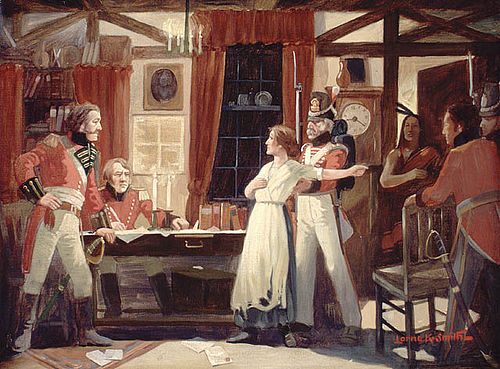
"Laura Secord Warns FitzGibbon" — Lorne K. Smith, c. 1920. Public domain.
Opposing Forces
Lt. James FitzGibbon; Capt. Dominique Ducharme
~400 Caughnawaga and Mohawk warriors, ~50 regulars (49th Foot)
Casualties: ~25 killed and wounded
Lt. Col. Charles Boerstler
14th US Infantry, cavalry, artillery
Casualties: ~500 captured
The Battle of Beaver Dams, fought on 24 June 1813, was one of the war’s most striking demonstrations of Indigenous military capability. A force in which warriors outnumbered British regulars by nearly ten to one defeated and captured an entire American column, and the engagement entered Canadian national memory through the legend of Laura Secord’s warning walk.
Following the American setback at Stoney Creek, the occupying force at Fort George sought to reassert control of the Niagara peninsula. An American column of approximately 575 men under Lieutenant Colonel Charles Boerstler was dispatched to attack a small British outpost at DeCew House, near the village of Beaver Dams. The force comprised regular infantry of the 14th US Regiment, supported by cavalry and a field gun.
The British were warned of the American approach. The most celebrated account credits Laura Secord, a Loyalist civilian from Queenston, who walked nearly 20 miles through difficult terrain – including swamp and dense forest – to reach FitzGibbon’s position and alert him. Whether Secord’s warning was the decisive intelligence or whether it confirmed information already received from Indigenous scouts remains debated, but her journey has become one of the foundational stories of Canadian national identity.
Captain Dominique Ducharme, commanding approximately 300 Caughnawaga (Kahnawake) warriors, with an additional 100 Mohawk warriors, positioned his force in the dense woodland along the route of the American advance. When Boerstler’s column entered the tree line, the warriors opened fire from concealed positions on multiple sides.
What followed was precisely the kind of engagement in which Indigenous warriors held every advantage. In the closed woodland, Boerstler’s regulars could not form the lines and volleys on which European-style infantry tactics depended. The cavalry was useless in the trees. The field gun could not be brought to bear on an enemy that was everywhere and nowhere. The Americans were pinned in place, taking casualties from an opponent they could barely see, for several hours.
When FitzGibbon arrived with approximately 50 men of the 49th Foot, the Americans were already demoralised and bleeding. FitzGibbon, displaying considerable nerve, approached Boerstler under a flag of truce and informed him that a much larger British force was approaching and that, should the fighting continue, the Indigenous warriors could not be restrained. Boerstler, his force disorganised and having already suffered significant casualties, surrendered his entire command.
The battle is significant for what it reveals about the war’s actual combatants. The engagement at Beaver Dams was fought and won overwhelmingly by Indigenous warriors. FitzGibbon’s 50 regulars arrived after the decisive fighting was over and contributed the bluff that secured the surrender, but the military outcome was determined by Ducharme’s Caughnawaga and Mohawk fighters. FitzGibbon himself acknowledged this candidly, writing that “not a shot was fired on our side by any but the Indians.”
The capture of Boerstler’s entire force further contracted the American perimeter around Fort George, making any further offensive operations from that base impractical. The Niagara campaign of 1813 had effectively ended in a series of British-Indigenous victories that reversed the initial American success at Fort George.
Significance
Underscored the military effectiveness of Indigenous warriors in woodland combat and further contracted the American perimeter on the Niagara peninsula.