Battle of Bladensburg
24 August 1814
"Battle of Bladensburg" — unknown artist, c. 1814. Engraving. Public domain.
Opposing Forces
Maj. Gen. Robert Ross
4th, 21st, 44th, 85th Foot, Royal Marines - Peninsular War veterans
Casualties: 64 killed, 185 wounded
Brig. Gen. William Winder
Regulars, DC and Maryland militia, marines, flotillamen
Casualties: 26 killed, 51 wounded, ~100 captured
The Battle of Bladensburg, fought on 24 August 1814, opened the road to the American capital and produced one of the most humiliating military episodes in United States history. An American force of approximately 6,500 men – holding prepared positions with numerical superiority – was routed by 4,500 British veterans in an engagement that earned the derisive nickname “the Bladensburg Races” for the speed of the American retreat.
The British force that landed in the Chesapeake in August 1814 was qualitatively different from any that had operated in North America during the war. These were not garrison troops or colonial militia – they were hardened veterans of the Peninsular War, men who had fought under Wellington at Salamanca, Vitoria, and Toulouse. Major General Robert Ross, their commander, was an experienced and aggressive officer who had distinguished himself in the Spanish campaigns.
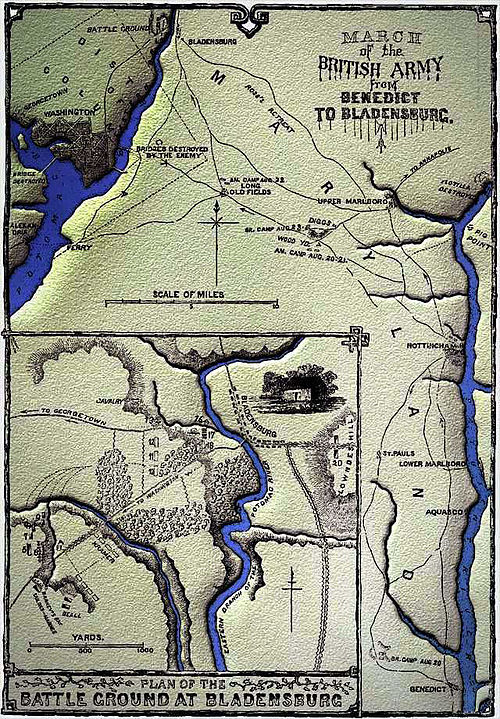
Ross’s objective was Washington. The decision to target the American capital was both military and psychological – the British sought to demonstrate that the United States, having invaded Canada and burned its capital, could not protect its own seat of government. The advance from the landing point at Benedict, Maryland, covered approximately 50 miles in five days – a brisk pace that kept the Americans off balance.
Brigadier General William Winder, commanding the defence of Washington, had been in his post for barely a week. His force was a hastily assembled collection of militia units, most of which had never trained together, supplemented by a small contingent of regulars, marines under Captain Samuel Miller, and Commodore Joshua Barney’s flotillamen – experienced sailors who had been fighting the British on the Chesapeake for months.
Winder positioned his force in three successive lines along the eastern bank of the East Branch of the Potomac (now the Anacostia River) at Bladensburg, where the road from the coast crossed the river. The position had natural advantages – the river provided an obstacle, and the ground behind offered some defensive benefit. But the defensive plan was improvised, the units were unfamiliar with each other and their officers, and the overall disposition lacked depth and coordination.
President James Madison, Secretary of State James Monroe, and other senior officials had ridden out from Washington to observe the battle – an extraordinary and somewhat surreal presence that added political confusion to the military variety. Monroe, a veteran of the Revolution, actually attempted to adjust the positions of some militia units, reportedly making the dispositions worse rather than better.
Ross’s advance brigade, the 85th Light Infantry, crossed the Bladensburg bridge under fire and deployed on the American side of the river with professional speed. The first American line, comprising militia units, broke under the combined effect of Congreve rocket fire and a disciplined infantry advance. The rockets – notoriously inaccurate as weapons – were devastating as psychological instruments against troops who had never experienced them.
The second American line held longer, but collapsed when British troops closed with bayonets. Militia units that had been wavering dissolved entirely, their retreat becoming a rout that carried soldiers, officers, and civilians westward toward Washington in a confused mass.
The third line, comprising Barney’s flotillamen and Miller’s marines, offered the only serious resistance of the day. These experienced troops – men who had been fighting for months and were accustomed to combat – held their ground and inflicted significant casualties on the advancing British. Barney himself, manning a battery of naval guns, was wounded and captured only when his ammunition was exhausted and the militia on both flanks had fled, leaving his position isolated and unsupported.
The American retreat became general. Madison, Monroe, and the cabinet departed Washington ahead of the British advance. The road to the capital lay open. By evening, Ross’s veterans were marching through the streets of the American capital – the only occasion since the Revolution on which a foreign army would do so.
Bladensburg was not a battle lost by American courage – Barney’s flotillamen and Miller’s marines demonstrated that Americans could fight when properly trained and led. It was a battle lost by American organisation, preparation, and the systemic weakness of relying on untrained militia to stand against professional soldiers. The approximately 6,500 Americans at Bladensburg outnumbered Ross’s 4,500 British, but numbers were irrelevant when one side comprised veterans of Europe’s bloodiest campaigns and the other comprised men who had, in many cases, never fired a musket in anger.
Significance
The collapse of the American defence despite numerical superiority reflected the fundamental disparity between Peninsular War veterans and hastily assembled militia. It opened the road to Washington.