Battle of Chateauguay
26 October 1813
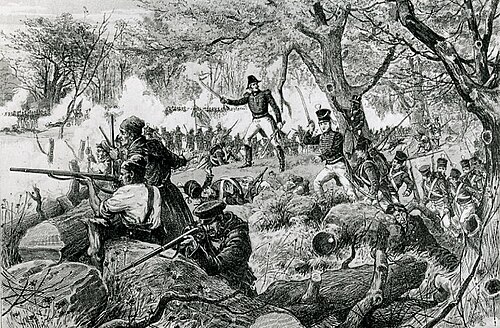
Battle of Chateauguay, 26 October 1813. Henri Julien. Public domain.
Opposing Forces
Lt. Col. Charles de Salaberry
Canadian Voltigeurs, Select Embodied Militia, Abenaki warriors
Casualties: 5 killed, 16 wounded, 4 missing
Maj. Gen. Wade Hampton
Regular infantry and militia from the Lake Champlain corridor
Casualties: 23 killed, 33 wounded, 29 missing
The Battle of Chateauguay, fought on 26 October 1813 along the Chateauguay River in Lower Canada, was the war’s most extraordinary defensive action. Approximately 339 men — Canadian Voltigeurs, Select Embodied Militia, and Abenaki warriors — defeated an American force of over 3,000. The ratio of nearly one to ten makes Chateauguay one of the most lopsided defensive victories in modern military history. It secured the southern approach to Montreal and became a foundational event in French-Canadian national identity.
The Two-Pronged Offensive
The American plan for the autumn of 1813 was the war’s most ambitious offensive: a two-pronged advance on Montreal. Major General Wade Hampton would march northward from Lake Champlain with approximately 4,000 troops. Major General James Wilkinson would descend the St. Lawrence from Sackets Harbor with 8,000 men in 300 boats. If either force reached Montreal, the St. Lawrence supply line to Upper Canada would be severed and the province likely lost.
Donald Hickey identifies the fundamental flaw: “The plan required coordination between two generals who despised each other. Hampton and Wilkinson’s mutual loathing was a matter of public record. Neither would subordinate himself to the other, and neither trusted the other to fulfil his part of the operation.”
De Salaberry: The Defender
Lieutenant Colonel Charles de Salaberry was a French Canadian of distinguished military lineage. His father and three brothers had served in the British Army. He himself had entered British service as a teenager and had fought in the Netherlands, the West Indies, and the Peninsular War before returning to Canada to raise the Canadian Voltigeurs — an elite light infantry unit recruited from Quebec’s French-speaking population.
De Salaberry was, in every sense, a professional soldier operating at the highest level of his craft. Jon Latimer, in 1812: War with America, places him among the war’s outstanding commanders: “De Salaberry combined the tactical intelligence of a European professional with an intimate knowledge of North American terrain and warfare. The result was a defence that exploited every advantage the ground offered.”
The Preparation
De Salaberry prepared his position with meticulous care. He constructed a series of abattis — barriers of felled trees with sharpened branches facing the enemy — across the approaches. He positioned his men in concealed firing positions along the river and in the surrounding forest. Most critically, he prepared an elaborate deception: buglers were posted at multiple positions deep in the woods, instructed to sound calls that would suggest the presence of large formations in the forest on both flanks.
The position was layered: a forward line to absorb and slow the American advance, intermediate positions to fall back to, and a reserve under Lieutenant Colonel George Macdonell several miles to the rear. De Salaberry’s 339 men at the forward position were the tripwire; the deception was designed to make them seem like the advance guard of a much larger force.
The Battle
When Hampton’s column appeared on the morning of 26 October, de Salaberry’s plan unfolded with precision. The Voltigeurs opened fire from concealed positions, delivering accurate volleys that stopped the American advance. Bugles sounded from the forest on both flanks — seemingly from positions far to the American rear. Abenaki warriors raised war cries from multiple directions. The overall impression — carefully created through preparation rather than force — was that Hampton had walked into a much larger army.
Hampton attempted a flanking movement, sending Colonel Robert Purdy with a substantial detachment to cross the river and attack de Salaberry’s position from the opposite bank. The flanking column became disoriented in the dense forest, lost its way, and when it finally emerged, was engaged by militia positioned on the far bank. Purdy’s attack, uncoordinated and confused, achieved nothing.
Hampton, convinced that he faced a force substantially larger than actually existed and with his flanking movement having failed, ordered a withdrawal. The American force retreated to its starting position and subsequently marched away from the theatre entirely.
Casualties and Assessment
De Salaberry’s casualties amounted to five killed, sixteen wounded, and four missing — from a force of 339. American casualties were 23 killed, 33 wounded, and 29 missing — modest in absolute terms but irrelevant beside the strategic outcome.
Andrew Lambert places Chateauguay in the war’s broader strategic context: the battle proved that the St. Lawrence corridor — Canada’s lifeline — could be defended by relatively small forces if those forces were properly led and intelligently positioned. The American numerical advantage was rendered meaningless by terrain, preparation, and the quality of de Salaberry’s command.
Pierre Berton gives the battle its Canadian significance: “Chateauguay was the moment at which French Canada proved its commitment to the defence of British North America. The Americans had assumed that French Canadians, as a conquered people living under British rule, would welcome liberation. De Salaberry’s Voltigeurs demonstrated the opposite with a finality that left no room for doubt.”
Jeremy Black adds the wider perspective: the American assumption that French Canadians would defect was rooted in a fundamental misunderstanding of colonial politics. French Canadians had been guaranteed their language, religion, and legal traditions under British rule since the Quebec Act of 1774. They had no desire to exchange this arrangement for absorption into an English-speaking republic that had shown no interest in accommodating Catholic or francophone communities. Chateauguay was not merely a military victory — it was a political verdict delivered on the battlefield.
The battle became a foundational event in French-Canadian military identity. De Salaberry was celebrated as a national hero — a status he retains in Quebec to this day. His portrait hangs in the Canadian War Museum. The battlefield is a national historic site. And the story of 339 men who held the line against 3,000 has become one of the defining narratives of Canadian national consciousness.
Significance
The war's finest defensive action. Lieutenant Colonel Charles de Salaberry's 339 Canadian Voltigeurs, militia, and Abenaki warriors defeated over 3,000 Americans through preparation, deception, and personal leadership. The battle secured the southern approach to Montreal and became a foundational event in French-Canadian military identity, proving that French Canadians would fight to defend British North America.