Battle of Frenchtown (River Raisin)
22 January 1813
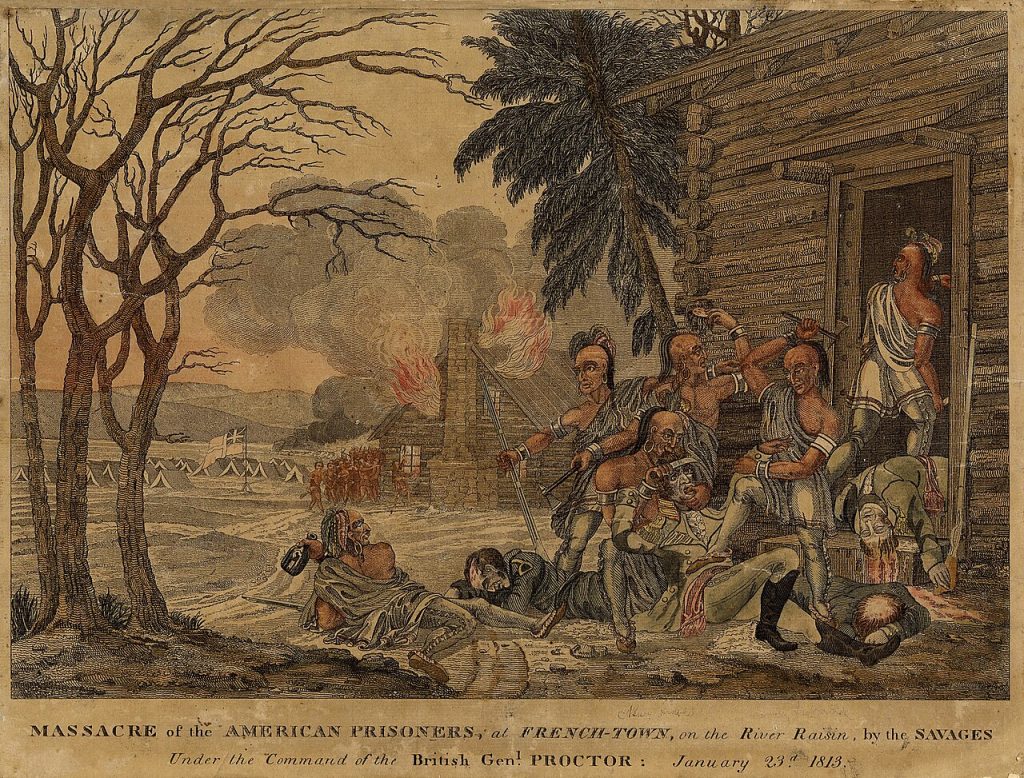
"Battle of the River Raisin" — unknown artist, 19th century. Public domain.
Opposing Forces
Col. Henry Procter
Regulars, militia, and Indigenous warriors
Casualties: 24 killed, 158 wounded
Brig. Gen. James Winchester
Kentucky militia and regulars
Casualties: ~400 killed, ~500 captured
The Battle of Frenchtown, fought on 22 January 1813 at the River Raisin in present-day Monroe, Michigan, was both a British tactical victory and a propaganda catastrophe. The battle itself was a straightforward engagement in which a British-Indigenous force overran an American position; its aftermath—in which a number of American wounded were killed by Indigenous warriors—became one of the war’s most potent American rallying cries.
An advance guard of approximately 1,000 Kentucky volunteers under Brigadier General James Winchester had occupied the settlement of Frenchtown on the River Raisin in mid-January 1813, intending to establish a forward position for the eventual recapture of Detroit. The Kentuckians were motivated by a mixture of patriotism and frontier belligerence, but they were poorly supplied, inadequately fortified, and operating well ahead of their main force under William Henry Harrison.
Colonel Henry Procter, commanding the British garrison at Amherstburg following Brock’s death at Queenston Heights, recognised the opportunity. He assembled a mixed force of regulars, Canadian militia, and Indigenous warriors—approximately 1,300 men in total—and advanced on Frenchtown in the predawn hours of 22 January.
The attack fell on the American right wing, which was positioned in open ground south of the settlement. This portion of Winchester’s force was overwhelmed rapidly. The American left, sheltered behind the palisade fences of the village, fought with considerably greater tenacity. The fighting was close and brutal, particularly around the buildings where the Kentuckians used the structures as improvised fortifications.
Winchester himself was captured during the early phases of the battle, having blundered into the British lines while attempting to rally his troops. Under pressure from Procter—who suggested that continued resistance would result in the loss of British control over the Indigenous warriors—Winchester issued a general order of capitulation. The remaining American forces laid down their arms.
It was the aftermath that transformed Frenchtown from a minor British victory into an event of lasting consequence. A number of American wounded, left in the settlement under what the Americans understood to be a guarantee of protection, were killed by Indigenous warriors the following day. The precise circumstances remain debated—British apologists argue that Procter left an inadequate guard and that the killings were carried out by warriors whose customary treatment of prisoners differed from European conventions; American accounts characterise the event as a deliberate massacre facilitated by British negligence.
Whatever the truth, “Remember the Raisin!” became one of the war’s most effective American slogans. Recruitment surged in Kentucky and the western states. The incident was cited in virtually every subsequent American call to arms in the northwest theatre, and it contributed to an enduring narrative—not entirely unjustified—that the British alliance with Indigenous nations carried inherent risks to the conventions of European warfare.
For the British, Frenchtown illustrated a persistent dilemma: Indigenous warriors were militarily indispensable but operated according to their own customs of war. Managing this alliance—extracting the military benefits while preventing incidents that could be exploited by American propagandists—was a challenge that British commanders never fully resolved.
Significance
A British tactical success that provided America with a powerful propaganda tool. The conduct question shadowed British-Indigenous cooperation for the remainder of the war.