Battle of Horseshoe Bend
27 March 1814
"Battle of Horseshoe Bend" — unknown artist, c. 1850. Public domain.
Opposing Forces
N/A - this was primarily US vs Creek Red Sticks
Red Stick Creek warriors (British-allied), estimated 1,000 warriors
Casualties: ~800 Red Stick warriors killed
Maj. Gen. Andrew Jackson
~2,600 militia and regulars + ~600 Cherokee and Lower Creek allies
Casualties: 47 killed, 159 wounded
The Battle of Horseshoe Bend, fought on 27 March 1814 at the Tallapoosa River in present-day Alabama, was the decisive engagement of the Creek War – a conflict intertwined with but distinct from the broader War of 1812. Andrew Jackson’s overwhelming victory over the Red Stick Creek shattered the most powerful Indigenous military force in the southeastern United States and opened vast territories to American settlement. It also established Jackson’s reputation as a military commander – a reputation that would carry him to New Orleans, the presidency, and the Indian Removal Act.
The Creek War had erupted in 1813, driven by the same tensions between American expansion and Indigenous resistance that animated the broader conflict. The Red Stick faction of the Creek Nation – so named for their war clubs, painted red to signify warfare – had been influenced by Tecumseh’s message of pan-Indigenous resistance during his 1811 visit to the South. They launched attacks on American settlements and, most notoriously, assaulted Fort Mims on 30 August 1813, where several hundred Americans were killed.
Jackson, commanding Tennessee militia and later augmented by regulars and Indigenous allies (Cherokee, Choctaw, and Lower Creek warriors who opposed the Red Sticks), conducted a brutal campaign through the Creek heartland during the winter of 1813-14. His advance was marked by several engagements and by the systematic destruction of Creek towns and food supplies.
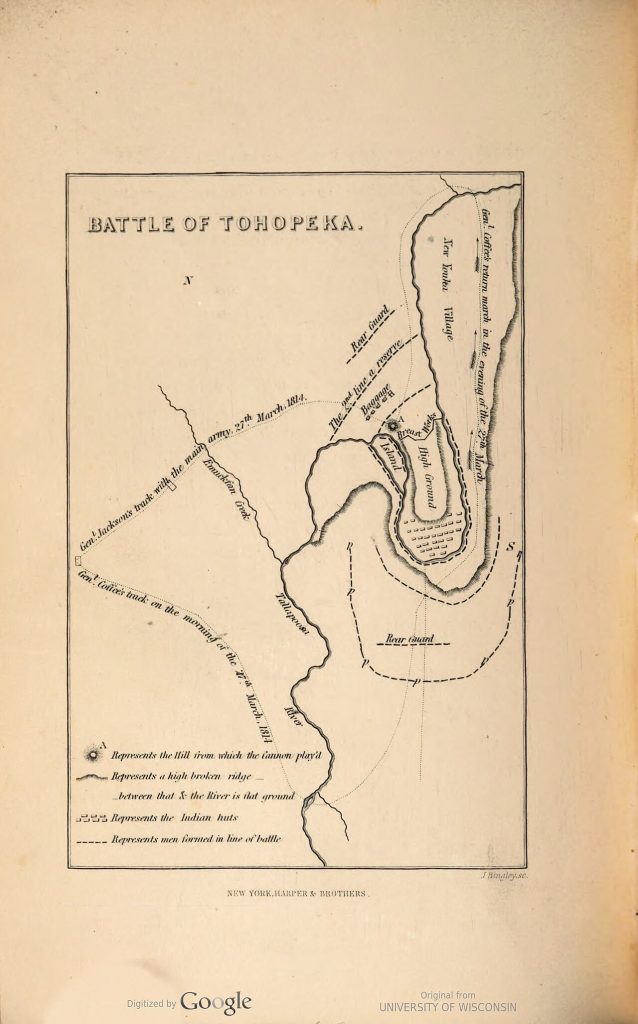
By March 1814, the Red Sticks had concentrated their remaining strength at Tohopeka, a fortified position on a horseshoe-shaped bend of the Tallapoosa River. The river formed a natural moat on three sides of the position, and the Red Sticks had constructed a substantial log barricade – five to eight feet high and loopholed for rifle fire – across the neck of the bend. An estimated 1,000 warriors defended the position, along with several hundred women and children.
Jackson’s force numbered approximately 3,300: about 2,600 American militia and regulars, plus approximately 600 Cherokee and Lower Creek allies. His plan was direct. The Cherokee and Lower Creek allies would swim the river behind the fortification, attacking from the rear and cutting off retreat. Jackson’s regulars and militia would assault the barricade frontally.
The Cherokee contingent, under the leadership of Major Ridge and others, crossed the river and set fire to some of the structures within the fortification, creating chaos in the Red Stick rear. Jackson then ordered the assault on the barricade. The fighting was ferocious – hand-to-hand combat over and through the log wall that continued for hours. The Red Sticks, recognising that they were surrounded and that the position was lost, fought with the desperation of men who expected no quarter and asked for none.
The result was devastation. An estimated 800 Red Stick warriors were killed – the overwhelming majority of the defending force. Jackson’s casualties were 47 killed and 159 wounded. The disparity reflected the totality of the defeat: this was not a battle in which the losing side withdrew to fight another day. The Red Stick military capability was annihilated.
The Treaty of Fort Jackson, imposed in August 1814, compelled the cession of approximately 23 million acres of Creek territory – roughly half of present-day Alabama and a fifth of Georgia. The treaty was imposed not only on the Red Stick faction but on the entire Creek Nation, including the Lower Creek allies who had fought alongside Jackson. The distinction between enemy and ally was, in this context, irrelevant: American territorial ambition recognised no such categories.
Horseshoe Bend is significant within the War of 1812 for what it reveals about the war’s actual outcomes. America’s most decisive military successes during this period came not against Britain – where three invasions of Canada failed and the capital was burned – but against Indigenous peoples who lacked the military resources to resist concentrated American force. Jackson’s victory at Horseshoe Bend, like Harrison’s at the Thames, achieved American objectives that had nothing to do with the stated causes of the war and everything to do with the continental expansion that was its deeper motivation.
Significance
Ended the Creek War and established Jackson's military reputation. The territorial gains came at the expense of Indigenous nations, not Britain.