Battle of Lake Borgne
14 December 1814
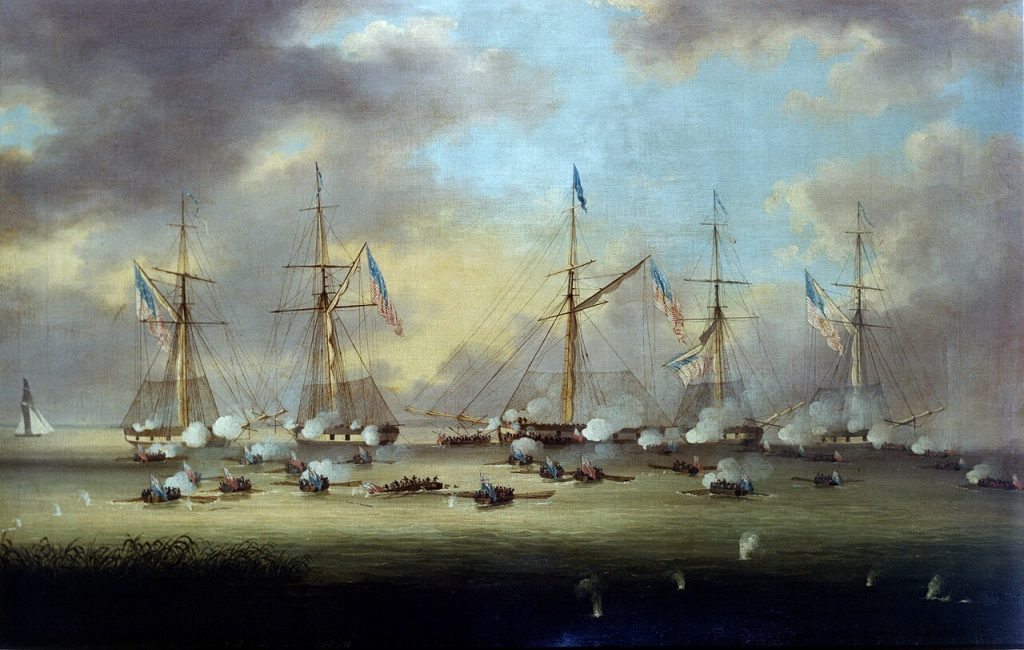
"Battle of Lake Borgne" — Thomas Lyde Hornbrook, c. 1815. Oil on canvas. Public domain.
Opposing Forces
Capt. Nicholas Lockyer
Royal Marines, sailors from the fleet in ship's boats and barges
Casualties: 17 killed, 77 wounded
Lt. Thomas ap Catesby Jones
5 gunboats and 2 small tenders
Casualties: 10 killed, 35 wounded; all vessels captured
The Battle of Lake Borgne, fought on 14 December 1814, was a necessary preliminary to the British assault on New Orleans. A flotilla of ship’s barges manned by over a thousand sailors and Royal Marines rowed across the shallow lake to attack and capture the small American gunboat squadron that constituted the sole naval defence of the eastern approaches to the city.
Lake Borgne (actually a shallow bay connected to the Gulf of Mexico) lay east of New Orleans, and any British approach from the coast to the city had to cross it. Lieutenant Thomas ap Catesby Jones commanded five gunboats and two small tenders — modest vessels, but their guns could command the shallow waters where British frigates could not navigate. As long as Jones’s gunboats survived, the British approach would be contested.
Captain Nicholas Lockyer assembled approximately 1,200 men in 45 ship’s boats and barges — an enormous undertaking that required the men to row over thirty miles across the open lake. The approach took hours, and the men were exhausted before the fighting began. But Lockyer had no alternative: the lake was too shallow for warships, and the gunboats had to be eliminated.
The engagement lasted approximately an hour. The American gunboats, anchored in a line, delivered effective fire against the approaching barges. Jones was wounded early in the action. But the sheer weight of numbers told: 1,200 men in 45 boats against 182 men in 7 vessels. The British boarded the gunboats one by one, fighting hand-to-hand on decks slippery with blood. Each vessel was taken after fierce resistance.
British casualties were significant for a boat action: 17 killed and 77 wounded. American losses were 10 killed and 35 wounded, with all vessels captured. The lake was now open, and the British army could proceed through the bayous toward New Orleans — though the delay caused by the necessity of the boat attack had given Jackson additional days to prepare his defences.
Significance
The capture of the American gunboat flotilla on Lake Borgne removed the only naval obstacle to the British approach to New Orleans through the bayous. It was a necessary preliminary to the main assault.