Battle of Lake Erie
10 September 1813
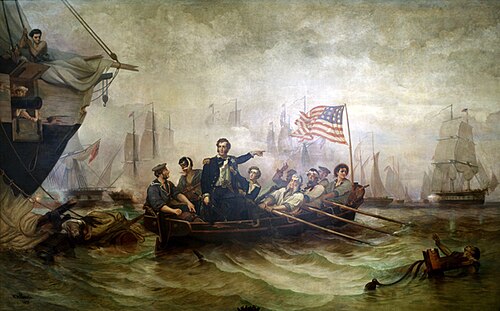
"Commodore Perry at the Battle of Lake Erie" — William Henry Powell, 1873. Oil on canvas, United States Senate. Public domain.
Opposing Forces
Cmdr. Robert Heriot Barclay
Provincial Marine squadron, largely crewed by soldiers and Canadian recruits rather than trained sailors
Casualties: 41 killed, 94 wounded
Master Cmdt. Oliver Hazard Perry
Purpose-built squadron with a higher proportion of trained naval personnel
Casualties: 27 killed, 96 wounded
The Battle of Lake Erie, fought on 10 September 1813 near Put-in-Bay in the western basin of the lake, was one of the war’s genuinely decisive engagements. It gave the United States uncontested control of Lake Erie, severed the British supply line to Detroit, and compelled the withdrawal that led directly to the Battle of the Thames and the death of Tecumseh. It was also a hard-fought action in which personal courage played a conspicuous role on both sides.
Control of Lake Erie was essential to British logistics in the northwest. Without the lake, there was no practical means of supplying the garrison at Amherstburg and the Indigenous allies who depended on British provisions. Both sides had engaged in a furious shipbuilding race during the spring and summer of 1813—the Americans at Presque Isle (present-day Erie, Pennsylvania), the British at Amherstburg.
Commander Robert Heriot Barclay, who had lost an arm at Trafalgar serving under Nelson, commanded the British squadron. His force was hobbled by chronic shortages. His flagship, HMS Detroit, went into action with guns collected from the ramparts of Fort Malden—a heterogeneous assortment that complicated ammunition supply. Much of his crew consisted of soldiers and Canadian recruits who had never served aboard ship. He was, in effect, fighting with improvised vessels crewed by amateurs against purpose-built warships crewed by professionals.
Master Commandant Oliver Hazard Perry’s American squadron, constructed from green timber at Presque Isle under the direction of shipbuilder Noah Brown, enjoyed advantages in both weight of broadside and crew quality. Perry had nine vessels to Barclay’s six, though the disparity in total firepower was less than the numbers suggest—the British long guns had greater range, while the American carronades were devastating at close quarters but ineffective at distance.
The battle began in the early afternoon. Barclay attempted to exploit his advantage in long guns by engaging at range, but the light and variable winds made manoeuvring difficult for both sides. Perry’s flagship, the brig Lawrence (named for the captain killed aboard Chesapeake), bore the brunt of the British fire as it closed the range. Within two hours, Lawrence was a wreck—most of her crew were casualties, her guns were silenced, and the vessel was effectively out of the fight.
At this point Perry performed the action for which the battle is best remembered. He transferred from the shattered Lawrence to the fresh brig Niagara by rowing across open water under fire—a distance of approximately half a mile. The small boat was an obvious target, but Perry reached Niagara unscathed, took command, and broke through the British line.
Niagara’s close-range carronades, brought to bear against already damaged British ships, proved decisive. Barclay, who had been wounded five times during the engagement—including injuries to his remaining arm—was unable to continue directing the battle. One by one, the British vessels struck their colours. Perry’s laconic dispatch to Harrison—”We have met the enemy and they are ours: two ships, two brigs, one schooner and one sloop”—became one of the war’s most quoted lines.
The strategic consequences were immediate and far-reaching. Without Lake Erie, the British position at Amherstburg and Detroit was untenable. Procter ordered a retreat up the Thames River, pursued by Harrison’s army. The Battle of the Thames, fought on 5 October, completed the American recovery of the northwest and cost Britain its most formidable ally. The chain of causation from Lake Erie to Tecumseh’s death was direct and unbroken.
Perry’s victory was a genuine achievement, won through personal courage and the advantages of superior ship construction. It should be noted, however, that it was an inland lake action against an improvised enemy squadron, not an oceanic engagement against the Royal Navy proper. The distinction matters: it was on the Atlantic that the question of naval supremacy was decided, and there the answer was never in doubt.
Significance
Perry's victory was the most consequential American naval achievement in the western theatre. It compelled the British withdrawal from Detroit and set the conditions for the Battle of the Thames.