Battle of New Orleans
8 January 1815
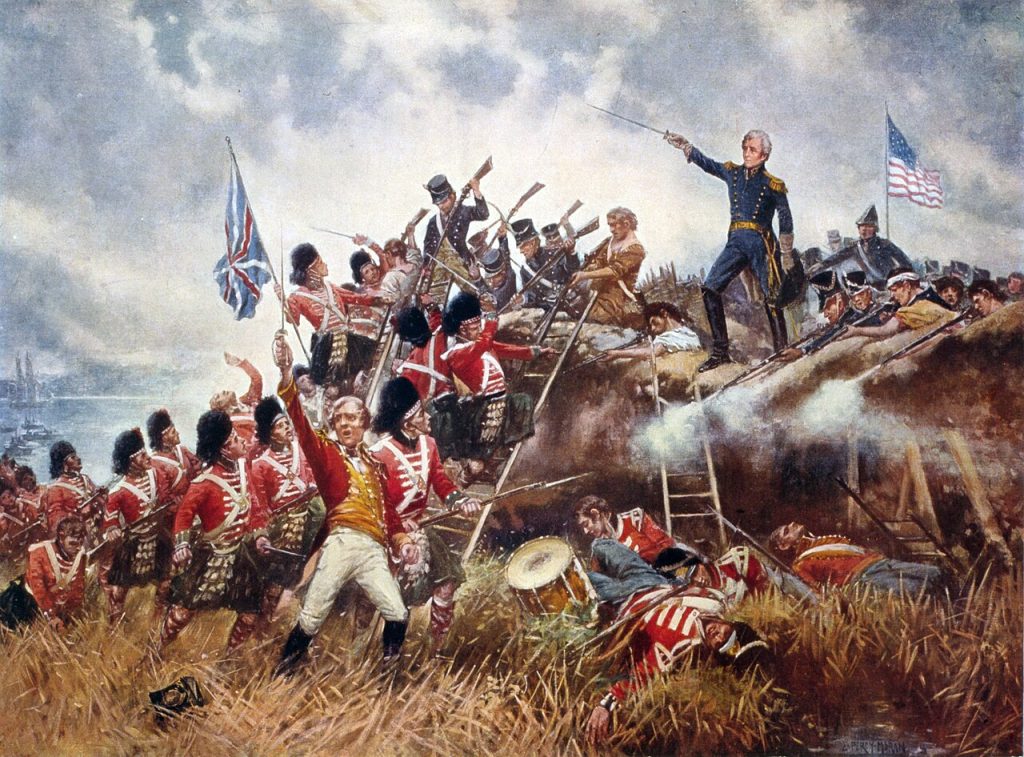
Battle of New Orleans, 8 January 1815. Dennis Malone Carter. Public domain.
Opposing Forces
Maj. Gen. Sir Edward Pakenham (killed)
4th, 7th, 21st, 43rd, 44th, 85th, 93rd, 95th Foot - Peninsular veterans
Casualties: 291 killed, 1,262 wounded, 484 captured/missing
Maj. Gen. Andrew Jackson
Regulars, Tennessee and Kentucky militia, marines, Baratarian privateers, free men of colour
Casualties: 13 killed, 39 wounded, 19 missing
The Battle of New Orleans, fought on 8 January 1815, was the largest engagement of the War of 1812, one of the most lopsided major battles in modern military history, and – in the final analysis – completely irrelevant to the war’s outcome. The Treaty of Ghent had been signed on 24 December 1814, two weeks before the battle. New Orleans changed nothing about its terms. Its enduring significance is not military but mythological: it provided the United States with the narrative of triumphant victory that its actual war record could not support.
The British Gulf Coast expedition was ambitious in conception. A force of some 8,000 troops – many of them veterans of the Peninsular War, the finest soldiers in the world – was tasked with capturing New Orleans and gaining control of the Mississippi River. The strategic implications were enormous: control of the Mississippi would sever the western United States from the east, provide leverage in the peace negotiations, and potentially establish a permanent British territorial presence in the Gulf.
Major General Sir Edward Pakenham, Wellington’s brother-in-law and a distinguished Peninsular commander, was appointed to lead the expedition. He arrived to find that his advance force had already established a precarious position south of New Orleans, having navigated the bayous and waterways below the city. The approach was logistically nightmarish – supplies had to be moved through miles of swamp, and the troops were operating at the end of an extremely extended supply line.
Andrew Jackson, commanding the American defence, had used the time well. He constructed formidable earthwork defences behind the Rodriguez Canal, a dry millrace that provided a ready-made trench line running perpendicular to the river. The position was anchored on the Mississippi on one side and an impassable cypress swamp on the other. Any frontal assault would be funnelled into a narrow killing ground covered by artillery and the rifles of Jackson’s mixed force of regulars, militia, marines, Jean Lafitte’s Baratarian privateers, and free men of colour.
Pakenham’s plan for 8 January required simultaneous operations on both banks of the Mississippi. A force under Colonel William Thornton would cross the river and assault the American batteries on the west bank, whose guns could enfilade the British assault on the east bank. On the east bank, the main assault would advance against Jackson’s earthworks using fascines (bundles of cane to fill the ditch) and ladders.
The plan failed at virtually every point of execution. The river crossing was delayed by hours – the current was stronger than anticipated, the boats were insufficient, and the timing was irretrievably lost. Thornton’s force did eventually cross and succeed on the west bank, but too late to affect the main battle.
On the east bank, the 44th Regiment of Foot – assigned the critical task of carrying the fascines and ladders to the front of the assault – arrived at the jump-off position without them. In the confusion, the regiment had advanced without collecting the equipment that was essential for crossing the canal and scaling the earthworks. This single failure condemned the assault before it began.
The advancing British infantry, formed in dense columns, moved forward at dawn across open ground toward Jackson’s prepared position. The American artillery opened first, cutting swathes through the approaching columns with round shot and canister. Then the infantry fire began – a concentrated storm of musketry and rifle fire from behind solid earthworks at close range.
The slaughter was appalling. The 93rd Sutherland Highlanders, advancing in their distinctive formation, were cut to pieces. Pakenham, riding forward to rally the faltering advance, was struck by grapeshot and killed. Major General Samuel Gibbs was mortally wounded. Major General John Keane was wounded. In the space of minutes, the British lost their commanding general and both divisional commanders.
The surviving officers attempted to maintain the assault, but without fascines to cross the canal or ladders to scale the earthworks, the attack was physically impossible even before the devastating firepower rendered it suicidal. The columns broke, reformed, advanced again, and broke again. By mid-morning, the battle was over.
British casualties were staggering: 291 killed, 1,262 wounded, and 484 captured or missing. American losses were 13 killed, 39 wounded, and 19 missing. The disparity is almost without parallel in the history of warfare between European-trained armies.
The tactical verdict is unambiguous: the British assault on 8 January was a catastrophe. The combination of a flawed plan, critical execution failures (particularly the 44th Regiment’s bungling), and the formidable strength of Jackson’s position produced a disaster. Jackson’s defensive arrangements were excellent, his troops fought with determination, and the result was a decisive American victory on the field.
The strategic verdict, however, is equally unambiguous: none of it mattered. The Treaty of Ghent, signed two weeks earlier, had already settled the peace on terms that restored the status quo ante bellum. Every territorial boundary returned to its pre-war position. Impressment was not mentioned. Neutral rights were not mentioned. New Orleans did not alter a single clause of the treaty.
What New Orleans did achieve was mythological. It provided the United States with a narrative of triumphant victory that could be placed at the end of the war’s story, allowing the preceding two and a half years of failed invasions, strategic defeats, and a burned capital to be reframed as a prelude to ultimate success. Andrew Jackson rode the mythology of New Orleans to the presidency. The battle became, in American popular memory, the defining moment of the war – the victory that “proved” America had won.
The historical record tells a different story. But as Andrew Lambert has observed, once established, a popular narrative is nearly impossible to erase, even when the documentary evidence contradicts it at every point.
Significance
A decisive American tactical victory with no bearing on the war's outcome, which was already settled by treaty. Its primary legacy is mythological rather than military.