Battle of North Point
12 September 1814
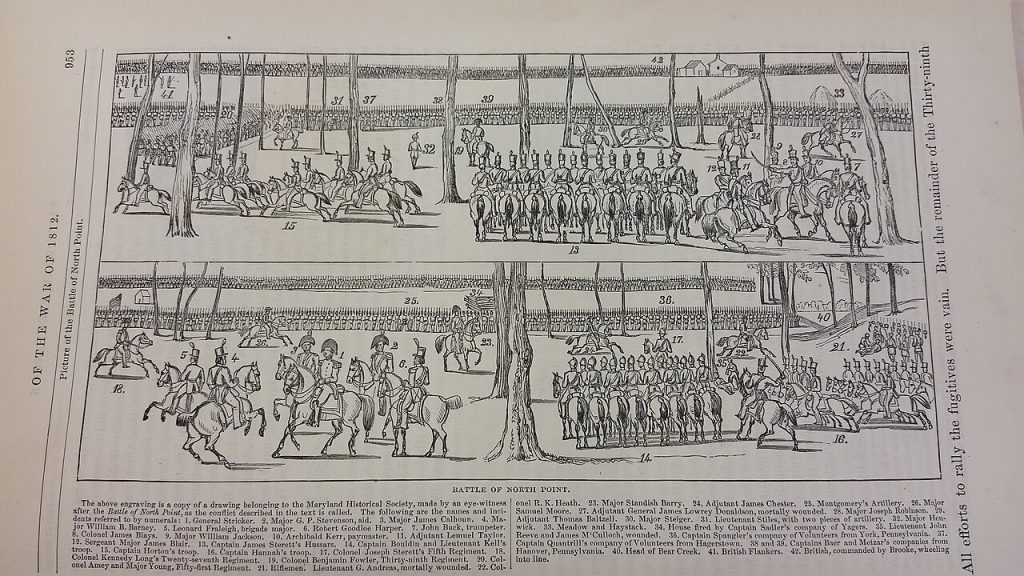
Battle of North Point, 12 September 1814. Public domain.
Opposing Forces
Maj. Gen. Robert Ross (killed), Col. Arthur Brooke
4th, 21st, 44th Foot, Royal Marines - Peninsular veterans
Casualties: 46 killed, 295 wounded (including Ross, mortally wounded)
Brig. Gen. John Stricker
Maryland militia, Baltimore city militia brigades
Casualties: 24 killed, 139 wounded, 50 captured
The Battle of North Point, fought on 12 September 1814, was a tactically inconclusive engagement that proved strategically decisive for a single reason: it killed Major General Robert Ross, the most aggressive and effective British field commander in the North American theatre. Without Ross, the British advance on Baltimore lost its driving force, and an operation that might have succeeded under his leadership was ultimately abandoned.
Ross’s Chesapeake campaign had been spectacularly successful. The same force that had routed the Americans at Bladensburg and burned Washington was now advancing on Baltimore – America’s third-largest city, a major commercial port, and the home base of many of the privateers that had been raiding British commerce. The city was a legitimate military target and a prize worth taking.
Baltimore, however, was better defended than Washington. Major General Samuel Smith, a veteran senator and experienced militia commander, had been organising the city’s defences for weeks. Unlike the hapless Winder at Bladensburg, Smith had time, resources, and the competence to use both. Earthworks were constructed, militia was drilled, and Fort McHenry – guarding the harbour approach – was reinforced and well supplied.
Ross landed his force at North Point, a peninsula east of Baltimore, on the morning of 12 September. His plan was to advance overland while the naval squadron, under Vice Admiral Alexander Cochrane, bombarded Fort McHenry and forced a passage into the harbour. The combined land and naval assault would overwhelm the city’s defences.
Brigadier General John Stricker, commanding a forward position with approximately 3,200 Maryland militia, was ordered to delay the British advance while Smith completed his fortifications. Stricker positioned his force across the peninsula and sent skirmishers forward to harass the approaching British column.
It was during this preliminary skirmishing that Ross was killed. He had ridden forward of his column to reconnoitre the American position – a habit of aggressive personal command that had served him well throughout his career but that, on this day, proved fatal. Two American riflemen, posted in concealment along the road, fired on the general’s party. Ross was struck in the chest and arm. He was carried to the rear, where he died within hours.
The loss of Ross was incalculable. He had led from the front at Bladensburg and Washington with a confidence and aggressiveness that his troops trusted and that intimidated his opponents. Colonel Arthur Brooke, who assumed command, was a competent officer but lacked Ross’s willingness to take calculated risks. The difference in temperament would prove decisive.
The battle itself continued after Ross’s death. The British infantry advanced against Stricker’s militia position and, after a sharp engagement lasting approximately two hours, drove the Americans from the field. Stricker conducted a creditable withdrawal in good order to the main defensive lines around Baltimore – a performance markedly superior to the militia collapse at Bladensburg. The Maryland militia, fighting to defend their own city, displayed a determination that the Washington militia had conspicuously lacked.
British casualties at North Point were 46 killed and 295 wounded – heavier than at Bladensburg, against a militia force of similar size. The Americans lost 24 killed, 139 wounded, and 50 captured. The numbers told a story: the defenders of Baltimore were fighting harder than the defenders of Washington had fought.
Brooke advanced his force to within sight of Baltimore’s fortifications on 13 September, but he found them far more formidable than anything the British had encountered at Bladensburg. Smith’s earthworks were substantial, his militia was in position, and the approach was well covered by artillery. Without Ross’s aggressive temperament to drive a frontal assault, and with the naval bombardment of Fort McHenry proving unsuccessful, Brooke concluded that the position could not be carried at acceptable cost.
The British withdrew on 14 September. Baltimore held. Ross’s body was preserved in a barrel of Jamaica rum and shipped back to Ireland for burial. The aggressive commander who had burned the American capital was dead at forty-eight, killed by a militiaman’s rifle while riding ahead of his troops in the manner that had always defined his leadership.
Significance
The death of Ross fundamentally altered the Baltimore campaign. Without his aggressive leadership, the British advance stalled and the operation was ultimately abandoned.