Battle of Plattsburgh
11 September 1814
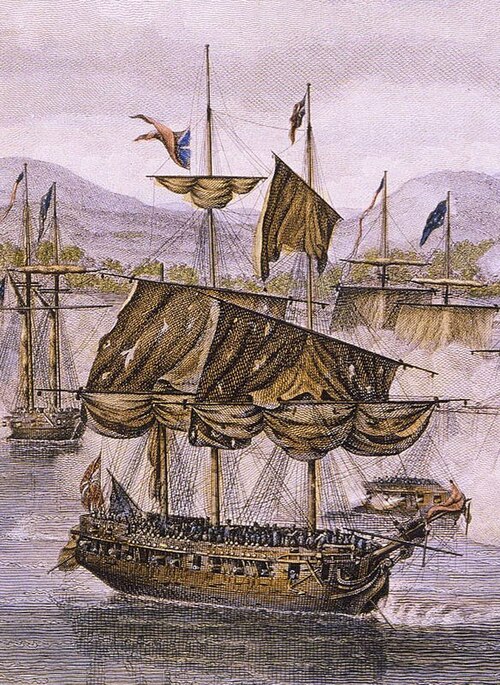
"Macdonough's Victory on Lake Champlain" — Hugh Reinagle, c. 1815. Oil on canvas. Public domain.
Opposing Forces
Lt. Gen. Sir George Prevost (land); Capt. George Downie (killed, naval)
Peninsular veterans: 3rd, 5th, 27th, 39th, 58th, 76th, 88th Foot; naval: Confiance, Linnet, Chubb, Finch + 12 gunboats
Casualties: Naval: ~170 killed, ~220 wounded, 4 ships lost; Land: ~200 casualties + desertions
Brig. Gen. Alexander Macomb (land); Cmdt. Thomas Macdonough (naval)
~1,700 regulars, ~2,500 militia; Saratoga, Eagle, Ticonderoga, Preble + 10 gunboats
Casualties: Naval: ~100 killed, ~120 wounded; Land: ~115 killed, ~130 wounded
The Battle of Plattsburgh, fought on 11 September 1814 on and around Lake Champlain in northern New York, was the largest engagement of the War of 1812 and the most significant American defensive victory of the conflict. A British invasion force of approximately 10,000 men — the most powerful army assembled by either side during the war, comprising veterans of the Peninsular War who had fought under Wellington — was turned back by a combination of innovative American naval tactics and the deeply controversial decision-making of the British commander, Sir George Prévost.
Napoleon’s Defeat and the Reinforcement of Canada
The context was Napoleon’s defeat. With the abdication of the French emperor in April 1814, Britain could redirect veteran regiments to North America for the first time. Thousands of seasoned troops — men who had served at Badajoz, Salamanca, Vitoria, and Toulouse — crossed the Atlantic during the summer of 1814. These were the finest infantry in the world, tested in some of the bloodiest campaigns of the Napoleonic era, and their arrival fundamentally altered the military balance in North America.
Sir George Prévost, the Governor General and commander-in-chief of British forces in Canada, chose to advance down the Lake Champlain corridor — the historic invasion route between Montreal and New York, used by armies since the French and Indian War. His force was formidable: brigades of Peninsular veterans including the 3rd, 5th, 27th, 39th, 58th, 76th, and 88th Regiments of Foot, supported by artillery, engineers, and a newly constructed naval squadron under Captain George Downie. The 88th — the Connaught Rangers — had fought at Badajoz, one of the most savage assaults in British military history. These were men who did not flinch.
The American Defence
The American position at Plattsburgh was defended by Brigadier General Alexander Macomb with approximately 1,700 regulars and 2,500 militia — a force outnumbered roughly three to one on land. The disparity in quality was even greater than the numbers suggest: Macomb’s regulars were competent but untested against Peninsular veterans, and his militia were of the variable quality that characterised American militia throughout the war.
The naval squadron, commanded by Master Commandant Thomas Macdonough, comprised four principal vessels — the corvette Saratoga (26 guns), the brig Eagle (20 guns), the schooner Ticonderoga (17 guns), and the sloop Preble (7 guns) — plus ten gunboats. Macdonough was thirty years old, a veteran of the Barbary Wars, and possessed of a tactical intelligence that would prove decisive.
Macdonough’s Innovation
Macdonough’s defensive preparation was the most brilliant piece of tactical thinking produced by either side during the entire war. He anchored his ships in Plattsburgh Bay with kedge anchors rigged on spring lines — heavy anchors set at angles from each vessel, connected by cables that could be winched to rotate the ship in place. This meant that each vessel could present a fresh, undamaged broadside to the enemy without weighing anchor or manoeuvring under sail. It was an innovation that transformed a static defensive position into one with the tactical flexibility of a mobile force.
He positioned his squadron so that Downie’s ships would have to round Cumberland Head and sail into the bay — a approach that denied the British the use of their long-range guns during the approach and forced them to engage at the close quarters where Macdonough’s carronades were most effective. The American vessels were positioned in a line that presented their broadsides to the bay’s entrance, maximising their firepower against any ship that entered.
The preparation was meticulous. Macdonough tested the kedge anchor system repeatedly before the battle. He calculated the angles. He drilled his crews on the winching procedure. He understood that the battle would be decided by preparation, not by chance, and he left nothing to chance.
Prévost’s Plan
Prévost’s plan required coordination between his army and Downie’s squadron. The navy would enter Plattsburgh Bay and destroy or drive off the American ships, after which the army would storm the American land defences from multiple directions. The plan was sound in conception: once the lake was under British control, the American position at Plattsburgh would be untenable, cut off from supply and reinforcement.
The execution, however, required precise timing between land and naval forces — precisely the kind of coordination that was most difficult to achieve in an era without reliable communication. Prévost pressured Downie to attack before the naval commander considered himself ready, and the relationship between the two men was strained before the battle began.
The Naval Battle: 11 September 1814
Downie’s squadron rounded Cumberland Head on the morning of 11 September and sailed into Plattsburgh Bay. His flagship, HMS Confiance — a powerful 37-gun frigate, the largest warship on the lake — led the approach, followed by the brig Linnet (16 guns), the sloops Chubb and Finch, and twelve gunboats.
Downie was killed within fifteen minutes of the engagement’s opening. A round shot from Saratoga struck one of Confiance’s guns and drove it backward off its carriage into Downie’s body. He died instantly. The loss of the squadron commander at the outset left the British ships without coordinated leadership at the moment when coordination was most critical.
The fighting that followed was among the most ferocious naval combat of the war. The ships engaged at close range — in some cases within pistol shot — and the casualties mounted with terrible speed. Confiance and Saratoga battered each other broadside to broadside. Eagle fought Linnet in a separate duel. The gunboats exchanged fire at close quarters. The water of the bay was said to have been stained red.
The decisive moment came when Saratoga had her starboard battery largely disabled — guns dismounted, ports shattered, the entire engaged side rendered ineffective. At this crisis, Macdonough employed his prepared kedge anchors. His crew winched the ship around on her anchor cables, presenting the undamaged port battery to the battered Confiance. The manoeuvre was executed under fire, with shot striking the hull and rigging throughout the rotation, and it required both extraordinary seamanship and the kind of preparation that only a commander who had anticipated this exact contingency could achieve.
Confiance, seeing Saratoga rotate and present fresh guns, attempted the same manoeuvre. She did not have kedge anchors rigged. Her crew attempted to wind ship using sails and remaining anchors, but the vessel stalled partway through the rotation — left beam-on to Saratoga’s fresh broadside, unable to bring her own guns to bear. The result was devastating. Saratoga poured broadside after broadside into the helpless Confiance at close range. Confiance struck her colours.
With the flagship taken, the remaining British vessels followed. Linnet fought on with distinction — her commander, Captain Daniel Pring, was one of the battle’s outstanding figures on either side — but when Chubb and Finch had both struck and Confiance was lost, Pring had no choice but to surrender. The battle had lasted approximately two and a half hours.
Prévost’s Decision
Prévost watched the naval defeat from the shore. His brigade commanders — Major General Frederick Robinson, Major General Thomas Brisbane, and Major General Manley Power, all experienced Peninsular officers — urged an immediate land assault. Robinson argued that his troops could carry the American positions by storm. The British outnumbered the American land forces by more than three to one, and these were veterans who had stormed fortified positions far more formidable than anything the Americans had constructed.
Prévost overruled them. He argued that without control of the lake, any position captured on the American side of the border could not be supplied or sustained through the coming winter. The logic had a certain abstract validity — logistics in an era of horse-drawn transport were genuinely dependent on water routes. But the decision to withdraw without even attempting the land assault, when his force was overwhelming and his troops were perhaps the finest available to any commander in North America, remains one of the most controversial command decisions of the entire Napoleonic era.
The retreat was ignominious. Soldiers who had fought through the bloodiest campaigns in Europe — men who had stormed Badajoz, who had held the line at Albuera, who had charged at Vitoria — were ordered to march back to Canada without having engaged the enemy. Desertions were significant: not from cowardice, but from disgust. Prévost’s officers never forgave him. He was recalled to England to face a court martial but died in January 1816 before it could convene, leaving the question of his judgment at Plattsburgh forever unresolved.
Casualties
Naval casualties were severe on both sides. The British lost approximately 170 killed and 220 wounded across the squadron, plus all four principal vessels captured. American naval losses were approximately 100 killed and 120 wounded. Macdonough himself was knocked unconscious twice during the action — once by the boom of a falling spar, once by the head of a decapitated midshipman that was flung across the deck and struck him. He returned to command on both occasions.
Land casualties were comparatively modest, given that the main assault never materialised. British losses from skirmishing and the aborted approach were approximately 200 killed, wounded, and deserted. American land casualties were approximately 115 killed and 130 wounded.
The Treaty of Ghent and the Myth of “Balance”
The diplomatic consequences of Plattsburgh have been consistently overstated in American historiography. The standard American account holds that the victory at Plattsburgh “balanced” the peace negotiations at Ghent, preventing Britain from dictating punitive terms. This narrative is misleading in a way that obscures the treaty’s actual content.
The Treaty of Ghent, signed on 24 December 1814, established the status quo ante bellum — every boundary returned to its pre-war position. This was precisely what Britain had been fighting for since June 1812. It was Britain’s stated war aim, achieved in full. The treaty did not mention impressment. It did not mention neutral rights. It did not mention the Orders in Council. It did not address any of the issues over which the United States had declared war. On every substantive question, the treaty reflected British terms.
The British did drop two proposals during the negotiations: the creation of an Indigenous buffer state in the northwest, and certain territorial adjustments along the border. These proposals went beyond Britain’s core war aims and were, in the assessment of the Duke of Wellington himself, unsupported by the military situation. Wellington, consulted by the Liverpool government in November 1814, advised that Britain had “no right, from the state of the war, to demand any concession of territory” — but this referred to territorial demands, not to the core issues of maritime rights and Canadian defence on which Britain conceded nothing.
It is sometimes argued that Plattsburgh forced these concessions. The argument is difficult to sustain. The British government had been moving toward a status quo ante bellum settlement since before Plattsburgh. The war was expensive, the European situation remained uncertain, and public enthusiasm for a continued North American conflict was limited. Plattsburgh may have reinforced these tendencies, but it did not create them.
What the treaty actually shows is this: the United States went to war over impressment, neutral rights, and the conquest of Canada. It achieved none of these against Britain. Britain went to war to defend Canada, maintain its maritime supremacy, and restore the status quo. It achieved all three. Calling this outcome “balanced” requires a definition of balance that is indistinguishable from British victory on every point of substance.
Assessment
None of this diminishes Macdonough’s achievement. The Battle of Plattsburgh was a genuine American triumph — tactically brilliant, courageously fought, and strategically significant in that it prevented a British army from occupying a substantial portion of New York. Macdonough’s innovation with the kedge anchors was the most creative tactical solution produced by any commander on either side during the war. His personal conduct under fire was exemplary.
But the tactical victory must be distinguished from the diplomatic outcome. Plattsburgh did not “save” the United States at Ghent, because the United States had already lost at Ghent on every issue that mattered. The treaty was going to restore the status quo ante bellum regardless of what happened at Plattsburgh — because the status quo ante bellum was what Britain wanted, and Britain held all the cards on the issues that had caused the war.
The war’s outcome was not determined at Plattsburgh. It was determined by the fundamental mathematics of naval power, commercial pressure, and strategic reality that had favoured Britain from the first day. Plattsburgh was a magnificent American defensive victory. It was also, in the larger story of the war, irrelevant to the terms on which it ended.
Significance
The most significant American defensive victory of the war and the largest engagement fought by either side. Macdonough's innovative use of kedge anchors decided the naval battle. Prevost's controversial retreat wasted the most powerful British army assembled during the conflict. The Treaty of Ghent, however, reflected British terms on every substantive issue regardless of Plattsburgh — impressment, maritime rights, and the status quo ante bellum were settled in Britain's favour.