Battle of Prairie du Chien
17-20 July 1814
"Fort Shelby, Prairie du Chien" — unknown artist, 19th century. Public domain.
Opposing Forces
Lt. Col. William McKay
Michigan Fencibles, Green Bay militia, ~530 Menominee, Sioux, Ho-Chunk, and Winnebago warriors
Casualties: Minimal
Lt. Joseph Perkins
1st US Infantry garrison of Fort Shelby; gunboat Governor Clark
Casualties: Fort surrendered; gunboat driven off
The Battle of Prairie du Chien, fought between 17 and 20 July 1814 in what is now southwestern Wisconsin, was one of the war’s most remote engagements — and one of its most illuminating. A British force operating over a thousand miles from its base at Mackinac captured an American fort on the upper Mississippi, demonstrating the extraordinary reach of British-Indigenous military cooperation in the continental interior.
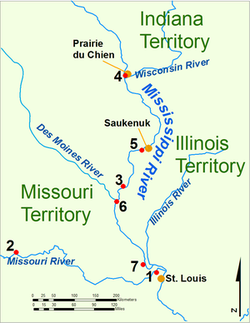
Prairie du Chien was a fur-trading settlement of considerable strategic importance. Situated at the confluence of the Wisconsin and Mississippi Rivers, it commanded the upper Mississippi trade routes and served as a nexus for relations between the American government and the Indigenous nations of the region. American forces had captured the settlement in June 1814, building Fort Shelby and garrisoning it with approximately 65 soldiers of the 1st US Infantry under Lieutenant Joseph Perkins.
Lieutenant Colonel William McKay assembled a mixed force at Mackinac that epitomised the British-Indigenous alliance: a small core of Michigan Fencibles and Green Bay militia, augmented by approximately 530 warriors from the Menominee, Sioux, Ho-Chunk, and Winnebago nations. This force travelled by canoe and overland for weeks to reach Prairie du Chien — a logistical achievement that underscored the operational capabilities of frontier warfare.
The siege was brief but effective. McKay’s force surrounded Fort Shelby and drove off the American gunboat Governor Clark with small arms fire. Cut off from resupply and reinforcement, with no prospect of relief, Perkins surrendered on 20 July after three days. The British occupied the post, renamed it Fort McKay, and maintained it for the remainder of the war.
A subsequent American attempt to recapture Prairie du Chien was defeated at the Battle of Credit Island on 21 July, when a relief force under Major Zachary Taylor (the future president) was driven back by British-allied warriors and a captured artillery piece. The upper Mississippi remained under effective British-Indigenous control until the Treaty of Ghent.
The significance of Prairie du Chien lies in what it reveals about the war’s geography and the nature of British power projection. While the main armies fought along the Niagara and the Atlantic seaboard, British influence — exercised primarily through Indigenous alliances — extended to the heart of the continent. The fur trade networks that sustained this reach were as much a strategic asset as any regiment of regulars.
Significance
British capture of this remote fur-trading post on the upper Mississippi extended their control deep into the American interior and maintained their Indigenous alliances far from the main theatres of war.