Battle of Queenston Heights
13 October 1812
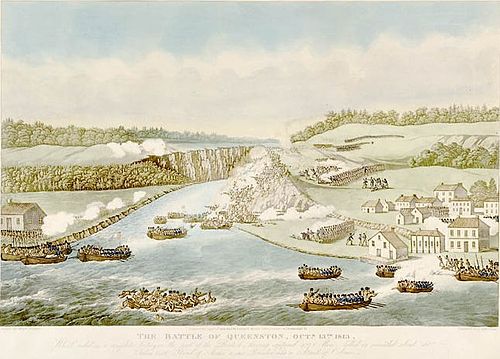
Battle of Queenston Heights, 13 October 1812. After John David Kelly. Public domain.
Opposing Forces
Maj. Gen. Isaac Brock (killed), Maj. Gen. Roger Sheaffe
49th Foot, Lincoln militia, Mohawk warriors under John Norton
Casualties: 14 killed, 77 wounded, 21 missing
Maj. Gen. Stephen Van Rensselaer
Regular army and New York militia (approximately 600 crossed the river)
Casualties: 90 killed, ~925 captured
The Battle of Queenston Heights, fought on 13 October 1812 along the Niagara escarpment in Upper Canada, occupies a singular place in the war’s history. It was the engagement that killed the British commander most capable of winning the war in Canada, and it exposed, more clearly than any other early action, the fatal weakness in American military organisation: the unreliability of state militia for offensive operations on foreign soil.
The Strategic Setting
Major General Isaac Brock, the administrator of Upper Canada and the architect of the Detroit triumph, had returned to the Niagara frontier in September 1812. The strategic situation was deceptively favourable for the Americans. Major General Stephen Van Rensselaer commanded approximately 6,000 men — a mix of regular army troops and New York militia — along the river from Fort Niagara to Fort Erie. Brock had fewer than 1,500 regulars, militia, and Indigenous warriors to defend the entire frontier.
Andrew Lambert, in The Challenge, frames the disparity: the American numerical advantage was overwhelming on paper, but it concealed a structural weakness that no amount of manpower could overcome. The militia component of Van Rensselaer’s force — the majority of it — could not be compelled to cross the border. This was not cowardice; it was constitutional reality. State militia served under state authority, and their obligation to defend the nation did not extend to invading a foreign country.
The Crossing and the Heights
The crossing began in predawn darkness on 13 October. The first waves, comprising regulars and volunteers under Colonel Solomon Van Rensselaer, crossed the Niagara under fire and established a foothold on the Canadian bank. Solomon Van Rensselaer was wounded six times during the crossing but survived — a feat of endurance that earned him the respect of both sides.
Captain John Wool discovered an unguarded fisherman’s path up the escarpment and gained the heights, outflanking the redan battery that had been firing on the boats. By mid-morning, approximately 600 Americans held the crest — a commanding position that, if reinforced and consolidated, could have served as a springboard for further operations into Upper Canada.
Brock’s Charge and Death
Brock was at Fort George, seven miles upriver, when he received word of the crossing. He rode immediately to the scene, arriving before most of his reinforcements. His decision to lead an immediate counterattack — rather than waiting for Sheaffe and the garrison — has been debated by military historians for two centuries.
Lambert’s assessment is characteristically direct: Brock’s charge was consistent with his aggressive temperament and his belief that momentum must be maintained, but it was reckless for an officer of his seniority and irreplaceability. No theatre commander should lead a company-strength charge up a defended slope. Brock knew this. He did it anyway.
He led approximately 100 men of the 49th Foot up the slope. He was conspicuous — tall, wearing his general’s uniform with its gold epaulettes, sword drawn. An American marksman fired from above. The ball struck Brock in the chest. He fell and died almost immediately. His aide-de-camp, Lieutenant Colonel John Macdonell, led a second charge and was himself mortally wounded. Both attempts failed to dislodge the Americans.
The loss of Brock was a catastrophe from which British command in Canada never fully recovered. Lambert argues that Brock was the only British commander in North America who combined the administrative competence to govern a province, the military skill to command in the field, and the personal charisma to inspire both regulars and militia. No subsequent commander — not Sheaffe, not Procter, not Prevost — possessed all three qualities. Brock’s death at forty-three deprived Britain of the one man who might have ended the war in 1812.
Sheaffe’s Flank Attack
Major General Roger Sheaffe, a more methodical officer, arrived from Fort George with reinforcements. Rather than repeat Brock’s frontal assault, Sheaffe conducted a flanking march along the escarpment, approaching the American position from the west with fresh troops and a substantial contingent of Mohawk warriors under the war chief John Norton.
Norton’s warriors were particularly effective. Their war cries added psychological pressure to the physical assault. The American position collapsed. Many soldiers surrendered rather than attempt the dangerous recrossing; others fell or were driven over the escarpment’s edge.
The Militia Refusal
The most consequential element of the battle occurred on the American bank. The New York militia — approximately 1,600 strong — refused to cross the river. They watched from the American shore as their countrymen were defeated, captured, and killed on the opposite bank. They invoked their constitutional right to decline service on foreign soil.
Lambert identifies this as the structural flaw that doomed the American war effort: “The United States went to war with an army designed for territorial defence, not for the invasion and conquest of a foreign country. At Queenston Heights, that contradiction was exposed in the most public and humiliating manner possible. Sixteen hundred men stood on the American shore and watched their countrymen die.”
This was not an isolated incident. The refusal of militia to cross international boundaries would recur throughout the war — at Detroit, at Niagara, at Plattsburgh, at Lacolle — and it represented a fundamental incompatibility between American military organisation and American strategic ambition. The United States had declared war to conquer Canada. Its army was constitutionally incapable of the task.
Jeremy Black, in The War of 1812 in the Age of Napoleon, places the militia refusal in the broader context of American state-building: the militia system was not a failure of nerve but a feature of a republic that distrusted standing armies. The same constitutional arrangements that protected American liberty made American conquest impossible. The irony was structural and inescapable.
Donald Hickey identifies the wider pattern: “The militia problem plagued every American offensive operation of the war. At Queenston Heights, at Lacolle Mills, at the Niagara crossings — the result was always the same. The United States could not compel its citizens to fight on foreign soil, and voluntary enthusiasm was no substitute for professional obligation.”
Casualties and Consequences
Total American casualties were approximately 90 killed and 925 captured — a substantial proportion of the force that had actually crossed. British losses were 14 killed (including Brock), 77 wounded, and 21 missing. The Niagara frontier would remain contested for two more years, but the first American invasion had been decisively repelled.
Brock became, in Canadian national memory, the foundational hero of the war. Pierre Berton, in The Invasion of Canada, gives him his most enduring characterisation: the man who saved Upper Canada in its hour of greatest peril. His monument at Queenston Heights — rebuilt after being damaged by a bomb in 1840 — remains one of Canada’s most important national landmarks.
Jon Latimer, in 1812: War with America, adds the British military assessment: Brock’s achievement at Detroit — persuading an army to surrender to a smaller force through bluff, speed, and psychological warfare — was one of the most extraordinary feats of the entire Napoleonic era. That he followed it with a death that secured his legend was, in Latimer’s phrase, “the kind of ending that belongs to mythology rather than history.”
For the Americans, Queenston Heights was the first indication that the conquest of Canada would not be the walkover that Jefferson had predicted. It would not be the last.
Significance
Brock's death deprived British North America of its finest commander. The battle exposed the fatal flaw in the American military system: militia who refused to cross into foreign territory. Approximately 1,600 New York militiamen watched from the American shore as their countrymen were defeated on the heights above. No subsequent British commander possessed Brock's combination of administrative ability, military audacity, and personal magnetism.