Battle of the Thames
5 October 1813
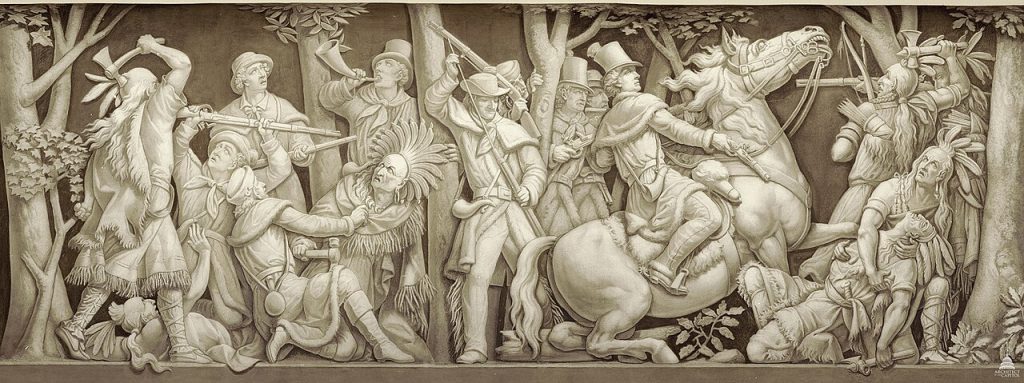
"Battle of the Thames and the Death of Tecumseh" — lithograph by Nathaniel Currier, c. 1846. Library of Congress. Public domain.
Opposing Forces
Maj. Gen. Henry Procter
~800 regulars (41st Foot) and ~500 warriors under Tecumseh
Casualties: 12 killed, 22 wounded, ~600 captured
Maj. Gen. William Henry Harrison
Kentucky mounted volunteers and US regulars
Casualties: 7 killed, 22 wounded. Tecumseh killed.
The Battle of the Thames, fought on 5 October 1813 along the Thames River in Upper Canada, was one of the war’s most consequential engagements—not for its military complexity, which was modest, but for its political and human consequences, which were immense. The battle destroyed the last organised Indigenous military resistance to American westward expansion and killed the most remarkable Native leader of the era.
Following Oliver Hazard Perry’s decisive victory on Lake Erie on 10 September, the British position at Amherstburg and Detroit became untenable. Without lake control, there was no means of supplying the garrison or its Indigenous allies. Major General Henry Procter, commanding in the absence of the late Isaac Brock, ordered a retreat eastward up the Thames River toward the head of Lake Ontario, where he hoped to link up with British forces on the Niagara frontier.
The retreat was badly managed. Procter had delayed his withdrawal for several critical days after Lake Erie, failing to prepare adequate logistics or establish defensive positions along the route. His regulars—the 41st Foot, which had served with distinction under Brock—were exhausted, hungry, and demoralised. Supplies were destroyed or abandoned as the column moved up the river. Discipline deteriorated.
Tecumseh was furious. In a council of war, he is recorded as comparing Procter to a fat animal carrying its tail between its legs—a devastating insult that reflected the depth of Indigenous frustration with British leadership in the northwest. Tecumseh had staked everything on the British alliance. He had assembled warriors from nations across the Great Lakes and Ohio Valley on the understanding that Britain would defend their territorial interests. The retreat from Detroit felt like a betrayal.
Harrison’s pursuit was energetic. His force—approximately 3,500 men, predominantly Colonel Richard Mentor Johnson’s regiment of mounted Kentucky volunteers—moved swiftly up the Thames, closing on the retreating British column. On the morning of 5 October, the two forces met near Moraviantown.
Procter formed his line across the road, with the 41st Foot in the centre and Tecumseh’s warriors positioned in a swamp on the right flank. The position was poorly chosen—the British line was thin, stretched, and lacked adequate artillery support. The regulars were drawn up in open formation, perhaps to compensate for their small numbers, but this left them vulnerable to cavalry.
Johnson’s mounted Kentuckians charged. The British regular line broke almost immediately—a shocking collapse for a regiment that had fought with distinction throughout the campaign. Most of the 41st were captured; Procter himself escaped on horseback and was later court-martialled for his conduct. The regular phase of the battle lasted barely minutes.
Tecumseh’s warriors, by contrast, fought with extraordinary tenacity. Positioned in the swamp, they engaged the American left in close combat that continued well after the British regulars had surrendered. Tecumseh was killed during this phase of the fighting. The precise circumstances of his death have never been established with certainty—multiple American participants later claimed the honour of having slain him, most prominently Colonel Johnson, who rode the association all the way to the vice-presidency of the United States in 1837.
The death of Tecumseh was the single most significant consequence of the battle, and arguably of the entire war. His pan-Indigenous confederacy—built over a decade through personal diplomacy, military skill, and extraordinary charisma—did not survive him. No successor possessed his combination of political vision and martial authority. The alliance fragmented. Nation after nation made separate accommodations with the advancing American frontier.
As the historian Alan Taylor has written, for Indigenous peoples, the War of 1812 was an unmitigated catastrophe. They lost their most capable leader, their political organisation, and ultimately their lands. The removal policies of the 1820s and 1830s—the Trail of Tears, the dispossession of the Old Northwest—were the direct descendants of the military reality established at the Thames. The one American war aim that was substantially achieved during the War of 1812 was achieved not against Britain, but against the Indigenous peoples who had allied with her.
Significance
The destruction of Tecumseh's confederacy removed the principal barrier to American westward expansion. This, rather than any concession extracted from Britain, represents the one American war aim substantially achieved.