Bombardment of Fort McHenry
13-14 September 1814
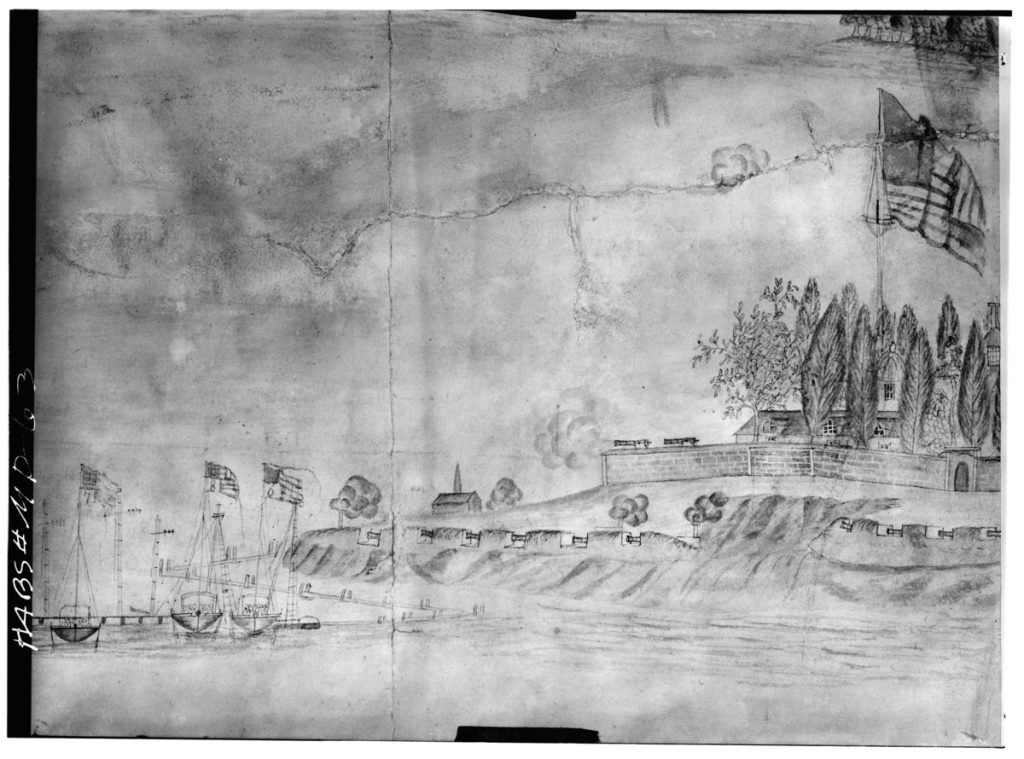
"Bombardment of Fort McHenry" — John Bower, c. 1814. Hand-coloured aquatint. Public domain.
Opposing Forces
Vice Adm. Alexander Cochrane
Bomb vessels HMS Erebus, Terror, Meteor, Devastation, Volcano; rocket vessel HMS Erebus; frigates and supporting ships
Casualties: Negligible
Maj. George Armistead
Fort McHenry garrison: regulars, volunteer artillery, militia
Casualties: 4 killed, 24 wounded
The bombardment of Fort McHenry, sustained over approximately twenty-five hours on 13-14 September 1814, was the naval component of the British assault on Baltimore. It failed to reduce the fort, failed to force a passage into the harbour, and failed to support the land attack that Ross’s death had already compromised. It also, through a coincidence of history, produced the poem that would become the American national anthem.
Fort McHenry, a star-shaped masonry fortification on Whetstone Point at the entrance to Baltimore’s inner harbour, was the key to the city’s naval defence. If the British squadron could pass the fort and enter the harbour, Baltimore would be vulnerable to bombardment and naval assault. If the fort held, the harbour was secure and the land force would have to take the city without naval support.
Major George Armistead commanded a garrison of approximately 1,000 men – regulars and volunteer artillerists – with a substantial complement of guns. He had also, at his own request, commissioned an enormous American flag – 42 feet by 30 feet – to fly over the fort. The flag, sewn by Mary Pickersgill, would become the most famous banner in American history.
The British bombardment began on the morning of 13 September. Vice Admiral Cochrane positioned his bomb vessels – specialised ships carrying heavy mortars capable of high-angle fire – at a range of approximately two miles from the fort. At this distance, the mortars could lob explosive shells over the fort’s walls, but the fort’s guns could not reach the bomb vessels. It was, in theory, a one-sided engagement.
In practice, it was less decisive than Cochrane had hoped. The bomb vessels fired an estimated 1,500 to 1,800 shells over the course of the bombardment – a sustained rate of roughly one shell per minute. The explosions were spectacular, particularly at night, when the bursting shells illuminated the sky over the harbour. But the damage to the fort was modest. The earthen and masonry construction absorbed much of the blast, and the garrison sheltered behind the walls during the heaviest firing.
When British ships attempted to close the range to bring more accurate fire to bear, the fort’s batteries opened up with devastating effect. Several bomb vessels were hit, and the squadron was forced back to its original, less effective range. A night attempt to run small boats past the fort under cover of the bombardment was detected and repelled by the fort’s guns and by militia positioned along the harbour shore.
Francis Scott Key, a Georgetown lawyer, watched the bombardment from a British truce vessel in the harbour. Key had boarded the ship to negotiate the release of a civilian prisoner and had been detained to prevent him from revealing British dispositions. Through the night of 13-14 September, Key watched the flashes of the bombardment and strained to see whether the fort’s flag still flew. At dawn on 14 September, the enormous American flag – Armistead’s oversized banner – was visible through the smoke. The fort had held.
Key wrote the poem “Defence of Fort M’Henry” on the back of a letter during and immediately after the bombardment. Set to the tune of “To Anacreon in Heaven,” a popular British drinking song, it was published as “The Star-Spangled Banner” and would eventually be adopted as the national anthem of the United States in 1931.
With Fort McHenry unsubdued, the harbour secure, and Ross dead, the British had no viable path to taking Baltimore. Cochrane and Brooke conferred and agreed to withdraw. The fleet departed, and the Chesapeake campaign – which had begun with the stunning success at Washington – ended with the failure at Baltimore.
The bombardment’s military significance was straightforward: it demonstrated that a well-fortified, well-garrisoned position could withstand sustained naval bombardment at the ranges available to early nineteenth-century ordnance. The fort’s casualties – four killed and twenty-four wounded from twenty-five hours of bombardment – speak to the limitations of the technology rather than any failure of British gunnery.
The bombardment’s cultural significance was immeasurable. A nation whose capital had burned three weeks earlier desperately needed a symbol of resistance and resilience. Fort McHenry provided it. The enormous flag, the night bombardment, the dawn revelation that the fort still stood – these became the elements of a national creation myth as powerful, in its way, as anything produced by the Revolution itself.
Significance
The defence of Fort McHenry ended British operations in the Chesapeake and provided the United States with its national anthem.