Capture of USS President
15 January 1815
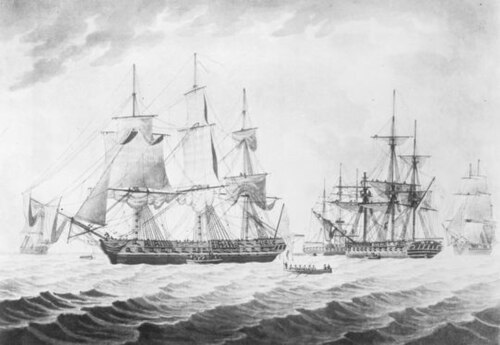
"Capture of USS President by the British Squadron" — Thomas Buttersworth, c. 1815. Oil on canvas. Public domain.
Opposing Forces
Cdre. John Hayes (squadron); Capt. Henry Hope (HMS Endymion)
HMS Majestic (56), Endymion (40), Pomone (38), Tenedos (38) - blockading squadron off New York
Casualties: 11 killed, 14 wounded (all aboard Endymion)
Cdre. Stephen Decatur
44-gun heavy frigate - America's most powerful warship afloat, commanded by its most celebrated captain
Casualties: 24 killed (incl. 3 lieutenants), 55 wounded
The capture of USS President on 15 January 1815 brought the Atlantic naval war to an end that was, in its way, as eloquent as any historian’s summary. America’s most powerful warship, commanded by America’s most celebrated naval officer, was pursued, engaged, and captured by a British blockading squadron. The ship was sailed to England as a trophy. Her lines were subsequently copied by British shipbuilders — the ultimate professional acknowledgement of American ship design alongside the military reality of American strategic defeat at sea.
Stephen Decatur: The Most Famous Captain
Commodore Stephen Decatur was the most famous naval officer in the United States — perhaps the most famous American military figure of his generation. His capture of HMS Macedonian in 1812, while commanding USS United States, had made him a national hero. His earlier exploits during the Barbary Wars — particularly the burning of the captured frigate Philadelphia in Tripoli harbour, which Nelson reportedly called “the most bold and daring act of the age” — had established his reputation for courage and audacity. He was brave, aggressive, skilled, and charismatic.
He was also, by January 1815, a man trapped by the very blockade that made his exploits necessary. For most of 1813 and 1814, Decatur had been blockaded — first at New London, Connecticut, where USS United States and the captured Macedonian were confined by a British squadron, and then at New York, where he had transferred his flag to the heavy frigate USS President.
The Blockade’s Grip
The blockade that imprisoned Decatur was the Royal Navy’s most consequential contribution to the war. By late 1814, it encompassed the entire American coast. American warships could leave port only during storms that scattered the blockading squadron, and even then at considerable risk. The great American frigates — the vessels whose early victories had so embarrassed the British — were progressively swept from the sea or confined to harbour.
USS Constitution made only sporadic sorties. USS United States rotted at her moorings in New London. USS Chesapeake had been captured by Shannon. USS Essex had been taken at Valparaiso. President was one of the last American frigates still capable of putting to sea — and she was penned in New York harbour by a British squadron commanded by Commodore John Hayes in the 56-gun razee HMS Majestic.
The Escape Attempt: 14 January 1815
On the night of 14 January 1815, a winter storm provided the opportunity Decatur had been waiting for. The wind had shifted, the seas were heavy, and the British blockading squadron had been driven from its station off Sandy Hook. Decatur ordered President to sea.
His plan was ambitious: reach the open Atlantic, proceed to the Indian Ocean, and destroy British merchant shipping in the East India trade routes. It was a commerce-raiding mission of the kind that had been the American navy’s most effective strategic contribution — attacking Britain’s vulnerable trade rather than contesting the impossible mathematics of fleet action. For a single frigate, it was a reasonable plan.
Disaster struck immediately. Despite the guidance of pilot boats marking the channel, President struck a sandbar at the harbour entrance. The ship pounded on the bar for nearly two hours in heavy seas before working free. The damage was severe and would prove fatal to the entire enterprise: copper sheeting was stripped from the hull below the waterline, reducing the ship’s speed; the masts were racked and twisted in their steps, compromising the rigging; and the hull itself was strained, opening seams that admitted water.
A less determined commander might have turned back. The ship was damaged, her sailing qualities degraded, and the blockading squadron, though scattered by the storm, was still in the vicinity. Decatur pressed on. It was a decision born of the same aggressive temperament that had made him famous — and, on this occasion, it would cost him everything.
The Chase: 15 January
At dawn on 15 January, the British blockading squadron was sighted. Hayes in Majestic led the pursuit, accompanied by the frigates HMS Endymion (40 guns), HMS Pomone (38 guns), and HMS Tenedos (38 guns). Four ships against one — and that one already damaged.
Decatur threw everything overboard that could be sacrificed for speed. Anchors, boats, spare spars, provisions, and water casks went over the side. The ship’s company pumped continuously to keep the water from the damaged hull under control. Despite these measures, President could not outrun the pursuit. The bar grounding had reduced her to a vessel slower than her pursuers.
HMS Endymion, widely regarded as the fastest frigate in the Royal Navy, gradually overhauled President through the morning and into the afternoon. Captain Henry Hope positioned Endymion on President’s starboard quarter — a position of devastating tactical advantage. From this angle, Endymion’s guns could rake President while most of President’s broadside could not bear on the pursuer.
The Engagement
The gunnery that followed was precise, sustained, and devastating. Hope’s gunners systematically destroyed President’s ability to fight. Six starboard guns were dismounted or had their barrels damaged beyond use. Ten of fifteen upper deck gunports on the engaged side were struck. Round shot penetrated below the waterline and was later found lodged inside President’s magazine — a discovery that, had it been made during the action, would have caused the crew to abandon the guns in terror of an explosion.
Decatur was struck by a splinter in the chest — a painful wound that he ignored to remain on deck. His first lieutenant had his leg torn off by a flying fragment of timber and was carried below. The second lieutenant was wounded. The third lieutenant was killed outright by a round shot. By the time the action had lasted two hours, three of President’s five lieutenants were casualties.
The carnage on President’s deck was appalling. Men were killed at their guns by shot that came through the hull timbers, showering the gun deck with splinters that were often more lethal than the round shot itself. The ship’s surgeon and his mates worked in near-darkness below the waterline, amputating limbs and extracting splinters while the deck above them shook with each impact.
The Double Surrender
President struck her colours at approximately 8 p.m., after more than two hours of engagement with Endymion alone. Total American casualties at this point were 24 killed and 55 wounded — a butcher’s bill that reflected the ferocity of Endymion’s gunnery.
However, Endymion’s boats had been destroyed during the engagement, and Hope could not immediately take possession of his prize. Decatur, seeing an opportunity, made sail and attempted to escape under cover of darkness. It was a desperate gamble — the act of a man who would rather risk death than accept the humiliation of surrender.
The gamble failed. Endymion completed hasty repairs and resumed pursuit. When Pomone and Tenedos closed in from other directions, firing into President from positions she could not effectively answer, Decatur recognised that further resistance was futile. He surrendered for the second time that night — a double capitulation that would haunt his reputation, fairly or not, for the remainder of his life.
The Passage to England
The damaged President and the wounded Endymion sailed in company toward Bermuda, where they encountered another storm that dismasted both ships. Both reached port safely, though the passage was hazardous. Decatur and his surviving officers were treated as prisoners of war with the professional courtesy customary between naval officers.
President was subsequently sailed to England, arriving at Spithead on 28 March 1815. Crowds gathered to see the captured American flagship — one of the heavy frigates whose early victories had so embarrassed the Royal Navy in the war’s opening months. The ship was examined with professional interest by British naval architects, who measured her lines, studied her construction, and took detailed plans.
The result was HMS President, a 60-gun frigate built by the Royal Navy as an exact copy of the American original. It was the supreme professional compliment: an admission that American ship design had, in certain critical respects, surpassed British practice. The copy was built alongside the military reality that the original now flew British colours.
The Arc of the Naval War
The arc of Decatur’s war encapsulated, in miniature, the arc of the entire American naval conflict. It began with triumph: the capture of Macedonian in 1812, when the American navy seemed capable of challenging British supremacy. It continued through frustration: the long months of blockade at New London and New York, as the Royal Navy tightened its grip on the American coast. It ended in capture: the flagship taken, the hero wounded and imprisoned, the navy’s challenge comprehensively answered.
Decatur survived the war and was exchanged. He was killed in a duel with Captain James Barron in 1820 — a death related, indirectly, to disputes arising from his wartime conduct and his role in Barron’s earlier court martial. He was thirty-one years old at the time of President’s capture and forty-one when he died. He remains one of the most celebrated figures in American naval history.
Andrew Lambert, in The Challenge, places President’s capture in the war’s wider naval narrative: the American frigate victories of 1812 had been genuine achievements, but they had created an illusion of strategic capability that the blockade and the subsequent captures systematically dismantled. President was the final act — the moment at which the American naval challenge was comprehensively and permanently answered.
Donald Hickey, writing as an American scholar, acknowledges the finality: “The capture of President was the last major naval action of the war, and it ended as the blockade had ensured it must — with an American warship in British hands. The navy had fought with honour throughout, but honour could not overcome the mathematics of the situation.”
Jeremy Black provides the European perspective: in the context of twenty years of global naval warfare, the American naval campaign of 1812-15 was an episode — a brief and dramatic challenge that the Royal Navy, once it adjusted its dispositions and concentrated its resources, answered with the same comprehensive superiority it had applied to every other maritime rival since Trafalgar.
But the story of USS President’s capture is not, ultimately, a story about one man or one ship. It is a story about the limits of courage and skill when set against the weight of strategic reality. The American navy fought with distinction throughout the War of 1812. Its officers earned the respect of their opponents — the highest compliment one professional service can pay another. Every American frigate that challenged the blockade after 1813 was captured: Chesapeake by Shannon, Essex by Phoebe, President by Endymion and her consorts. The pattern was consistent and the conclusion inescapable. The United States could build magnificent ships and train superb crews. It could not defeat the Royal Navy. No nation could.
Significance
The capture of America's most powerful warship and most celebrated captain concluded the Atlantic naval war. Every American frigate that put to sea after 1813 was captured or turned back. President was sailed to England as a trophy, and her lines were copied by the Royal Navy — the ultimate professional acknowledgement alongside the military reality of comprehensive American defeat at sea.