Cutting Out of HMS Detroit and Caledonia
9 October 1812
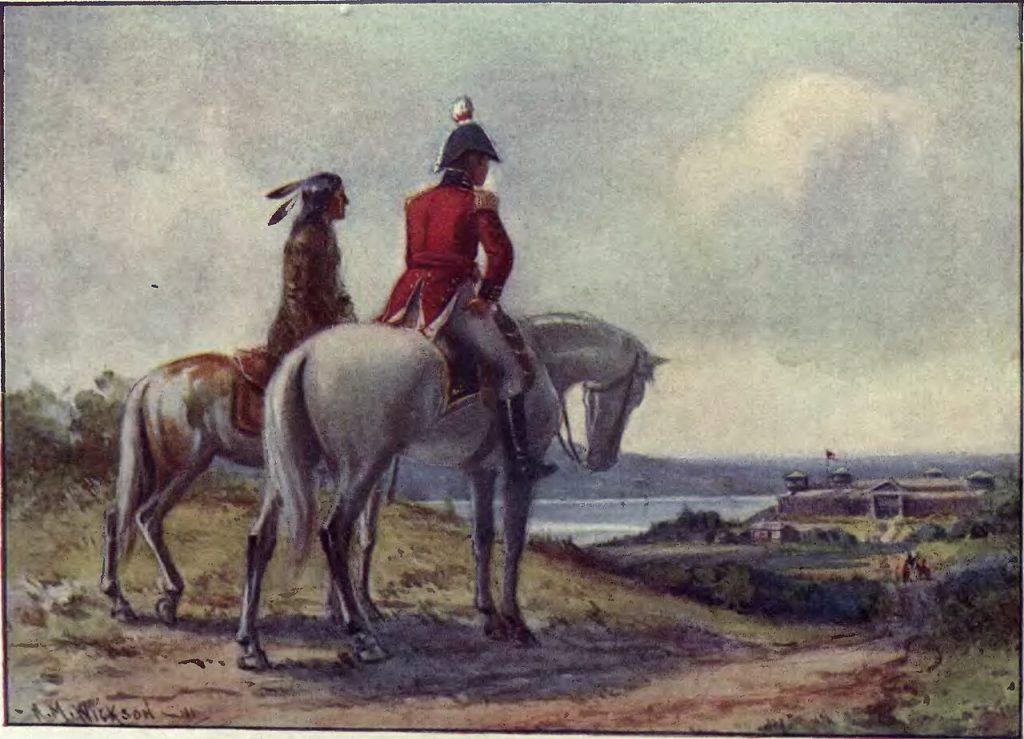
"Surrender of Detroit" — unknown artist, c. 1848. Oil on canvas. Public domain.
Opposing Forces
Lt. Frederic Rolette (captured)
Detroit (6 guns, formerly USS Adams, captured at Detroit) and Caledonia (2 guns, NWC brig) anchored under Fort Erie guns
Casualties: Minimal; both vessels captured
Lt. Jesse Elliott
US Navy sailors and soldiers in two boats, cutting-out operation at night
Casualties: 2 killed, 6 wounded
The Fall of Detroit on 16 August 1812 was the most dramatic and consequential engagement of the war’s opening months. Major General Isaac Brock, commanding a force substantially smaller than the garrison he faced, bluffed, manoeuvred, and psychologically overwhelmed Brigadier General William Hull into surrendering the entire American army of the northwest — approximately 2,000 men — without a serious fight. It was a masterpiece of audacity, and it set the tone for the entire war.
Hull’s Invasion
Hull had crossed into Upper Canada on 12 July 1812 with approximately 2,000 men — the first American invasion of the war. His advance was tentative from the outset. He issued a proclamation promising Canadians liberation from British tyranny, then hesitated, advanced and withdrew, and failed to capitalise on his numerical superiority. His supply lines were harassed by Indigenous warriors and Canadian militia. His intelligence was poor. His nerve was deteriorating.
Donald Hickey, in The War of 1812: A Forgotten Conflict, identifies Hull’s central problem: he was a Revolutionary War veteran in his late fifties, appointed to command for political rather than military reasons, and wholly unprepared for the reality of frontier warfare against an enemy who combined regular troops, militia, and Indigenous warriors in a coordination that the Americans could not match.
By early August, Hull had retreated to Detroit, convinced — with some justification — that his supply line was severed and that Indigenous forces were gathering in strength around his position. The British capture of the American outpost at Brownstown and the ambush at Maguaga confirmed that the road between Detroit and Ohio was no longer safe.
Brock’s Approach
Brock arrived at Amherstburg on 13 August, having made the journey from the Niagara frontier with characteristic speed. He immediately assessed the situation and concluded that boldness was the only viable strategy. His force was modest: approximately 300 regulars of the 41st Regiment, 400 Canadian militia, and some 600 Indigenous warriors under Tecumseh. Against Hull’s 2,000 men in a fortified position, conventional wisdom dictated caution.
Brock rejected conventional wisdom. He understood that Hull’s nerve was already failing and that the psychological dimension of the confrontation was more important than the military arithmetic. Everything that followed was designed to amplify Hull’s fears and undermine his will to resist.
Andrew Lambert, in The Challenge, frames Brock’s approach as a case study in the application of moral force: “Brock understood that wars are fought in the mind as much as in the field. Hull was afraid — of the Indigenous warriors, of the wilderness, of responsibility. Brock exploited every fear with the precision of a surgeon.”
The Surrender Demand
On 15 August, Brock sent Hull a formal demand for surrender. The letter was carefully crafted. It acknowledged Hull’s reputation, expressed a desire to avoid bloodshed, and then delivered the critical sentence: once the engagement commenced, Brock could not be responsible for the conduct of his Indigenous allies.
The threat was not idle — the spectre of an uncontrolled Indigenous assault on a fort containing soldiers’ families, including Hull’s own daughter and grandchildren, was designed to exploit Hull’s deepest fears. Jon Latimer, in 1812: War with America, notes that Brock was employing a tactic that the British had used effectively throughout the frontier wars: the implication that Indigenous warriors, once unleashed, could not be recalled. Whether this was true was irrelevant. What mattered was that Hull believed it.
Brock also arranged for a letter, ostensibly from Captain Adam Muir to a subordinate, to fall into American hands. The letter exaggerated the number of Indigenous warriors approaching Detroit, suggesting that 5,000 were on their way. The actual number was approximately 600. The deception worked.
Tecumseh’s Role
Tecumseh’s contribution was essential and operated on multiple levels. His warriors were visible in the tree line surrounding the fort — a constant reminder of the threat that Hull feared most. Tecumseh reportedly ordered his warriors to march through a clearing in view of the fort, then circle through the woods and march through again, creating the impression of a force many times its actual size.
Alan Taylor, in The Civil War of 1812, emphasises that Tecumseh was not merely a military instrument of British strategy but a strategic actor in his own right. The alliance with Brock served Tecumseh’s objectives as much as Britain’s: a successful defence of the northwest would strengthen the Indigenous confederacy and demonstrate that the British alliance could deliver results. Detroit was as much Tecumseh’s victory as Brock’s.
The Surrender
On the morning of 16 August, Brock crossed the Detroit River with his regulars and militia, landed south of the fort, and advanced toward the American position. Hull, observing the approaching force and convinced that thousands of warriors were about to descend on the fort, made the decision that ended his career and transformed the war: he surrendered.
The capitulation included not merely the Detroit garrison but also a detachment of approximately 400 men at the River Raisin, thirty miles to the south, who had not been engaged. Hull surrendered over 2,000 men, thirty-three guns, the brig Adams (renamed Detroit by the British), and vast quantities of military stores — to a force of approximately 1,300. It was one of the most extraordinary surrenders in military history.
Pierre Berton, in The Invasion of Canada, captures the magnitude: “In a single morning, without a shot fired in anger at the fort itself, Brock had captured an army, a territory, and the strategic initiative for the entire northwest. It was the kind of victory that belongs to legend rather than to the careful calculations of the staff officer.”
Consequences
The fall of Detroit transformed the war. Militarily, it exposed the entire American northwest frontier — from Mackinac to the Ohio River — to Indigenous attack. Fort Dearborn was destroyed within days. Fort Wayne was besieged. Settlements across Indiana and Ohio were threatened. The American war effort in the northwest was set back by a full year.
Politically, it was devastating. Hull was court-martialled, convicted of cowardice, and sentenced to death. The sentence was commuted by President Madison on account of Hull’s Revolutionary War service, but his reputation was destroyed. The surrender became a rallying point for American anger — and a cautionary tale about the consequences of appointing political generals to military commands.
Jeremy Black, in The War of 1812 in the Age of Napoleon, places Detroit in its strategic context: the fall demonstrated that the American military system, designed for territorial defence through militia, was wholly inadequate for offensive operations against a determined and intelligent enemy. The lesson would be learned slowly and at tremendous cost over the next two and a half years.
For Brock, Detroit was the triumph that cemented his legend. He had captured an army larger than his own through a combination of speed, audacity, and psychological manipulation that no other British commander in North America would match. Two months later, he would be dead at Queenston Heights. The man who had saved Upper Canada in its first hour of danger would not live to see the war’s end.
Significance
The most humiliating American defeat of the war. Brock captured an army larger than his own through a combination of audacity, psychological warfare, and the calculated exploitation of American fears about Indigenous allies. Hull was court-martialled and sentenced to death. The fall of Detroit exposed the entire northwest frontier and energised Indigenous nations across the Great Lakes region to ally with Britain.