First Battle of Fort Bowyer
15 September 1814
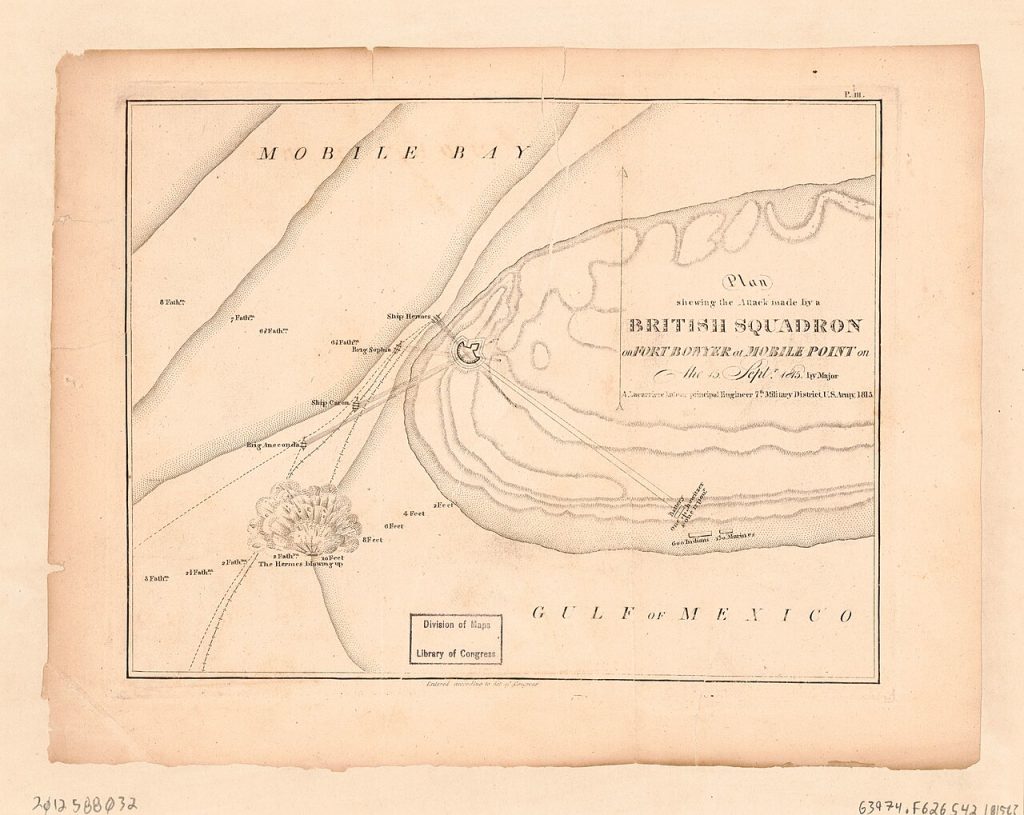
"Fort Bowyer, Mobile Point" — unknown artist, c. 1815. Public domain.
Opposing Forces
Capt. William Percy, RN
Royal Marines, Creek and Seminole warriors; HMS Hermes (22), Sophie (18), Carron (20), Childers (18)
Casualties: ~70 killed and wounded; HMS Hermes destroyed
Lt. Col. William Lawrence
2nd US Infantry, 14 guns
Casualties: 4 killed, 5 wounded
The First Battle of Fort Bowyer, fought on 15 September 1814, was a small engagement with large strategic consequences. A poorly coordinated British combined naval and land attack on an American fortification at the entrance to Mobile Bay was repulsed with significant British losses, including the destruction of the attacking flagship. The failure caused a fundamental redirection of British strategy in the Gulf of Mexico – away from the methodical approach through Mobile and toward the direct assault on New Orleans that would end in disaster four months later.
Fort Bowyer was a modest sand-and-log fortification on Mobile Point, a narrow peninsula commanding the entrance to Mobile Bay. The fort mounted fourteen guns in a crescent-shaped seaward bastion and was garrisoned by approximately 160 men of the 2nd US Infantry under Lieutenant Colonel William Lawrence. It was not an imposing position, but its location was strategically critical: whoever controlled Fort Bowyer controlled access to Mobile Bay, and through it, the overland routes connecting the Gulf Coast to the American interior.
The British strategy for the Gulf Coast, as originally conceived, called for the capture of Mobile as a preliminary to operations against New Orleans. Mobile would serve as a base of operations, and its possession would allow the British to approach New Orleans from the east via overland routes, avoiding the treacherous bayous and waterways south of the city. Fort Bowyer was the first obstacle on this path.
Captain William Percy, commanding a small naval squadron from Pensacola, was tasked with the fort’s reduction. His force consisted of four warships – HMS Hermes (22 guns), Sophie (18), Carron (20), and Childers (18) – and a land force of approximately 225 Royal Marines and approximately 130 Creek and Seminole warriors under Major Edward Nicolls, landed nine miles east of the fort along the peninsula.
The attack, launched on 15 September, was poorly coordinated from the outset. The land force, advancing along the narrow peninsula, failed to reach the fort in time to synchronise with the naval assault. Percy’s ships crossed the bar and engaged the fort at close range, but Fort Bowyer’s guns proved more effective than anticipated. The American gunners, well protected behind their earthworks, delivered accurate fire that raked the approaching vessels.
The decisive moment came when Percy’s flagship, HMS Hermes, ran aground directly under the fort’s guns at musket range. Unable to free the vessel and under devastating fire, Percy was forced to order his crew to abandon ship. Hermes was scuttled and subsequently blew up when the fire reached her magazine. Sophie’s boats rescued the surviving crew under continued fire from the fort.
After approximately two hours of engagement, Percy withdrew his remaining ships out of range. The land force, having arrived too late to influence the action and now without naval support, also withdrew. Total British casualties were approximately seventy killed and wounded, plus the loss of a warship. American casualties were four killed and five wounded – a dramatic disparity that reflected the advantage of fortified positions against naval attack.
The consequences of the repulse were far more significant than the battle itself. British commanders, concluding that Fort Bowyer could not be taken by the available naval force alone, abandoned the Mobile-first approach and opted instead for a direct assault on New Orleans through the bayous south of the city. This decision led directly to Pakenham’s frontal attack on Jackson’s prepared earthworks on 8 January 1815 – a decision that produced one of the most catastrophic British defeats of the entire Napoleonic era.
The irony is that when the British returned to Fort Bowyer in February 1815 with adequate forces and proper siege engineering, the fort fell in four days. The original strategy – Mobile first, then New Orleans – was sound. The failure at the First Battle of Fort Bowyer did not prove that the strategy was wrong; it proved that the execution had been inadequate. The consequences of that inadequacy were measured in the 2,000 British casualties at New Orleans.
Significance
The repulse redirected British strategy toward a direct assault on New Orleans - a decision with far-reaching consequences.