HMS Pelican vs USS Argus
14 August 1813
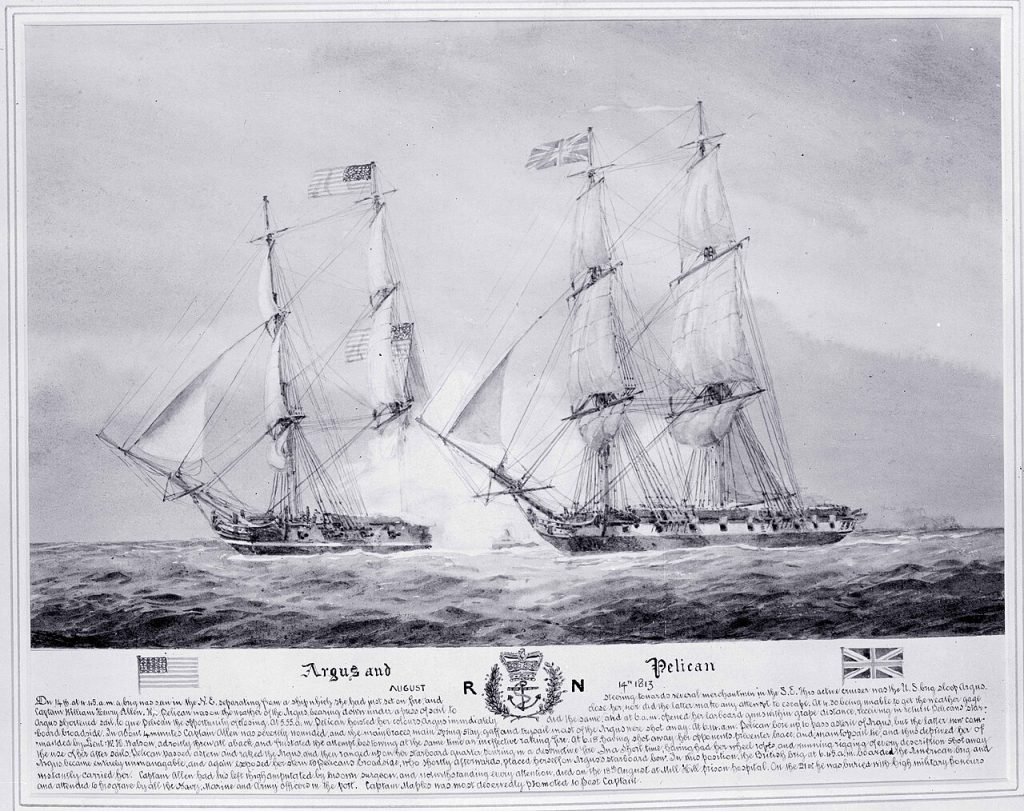
"HMS Pelican capturing USS Argus" — Thomas Whitcombe, c. 1816. Oil on canvas. Public domain.
Opposing Forces
Cmdr. John Fordyce Maples
18-gun brig-sloop, dispatched specifically to hunt Argus
Casualties: 2 killed, 5 wounded
Lt. William Henry Allen (mortally wounded)
18-gun brig-sloop; had been raiding British commerce in the Irish Sea for a month
Casualties: 6 killed (incl. Allen, died of wounds), 17 wounded; ship captured
The action between HMS Pelican and USS Argus, fought in St. George’s Channel off the Welsh coast on 14 August 1813, was a British frigate-sloop victory that ended one of the war’s most audacious American commerce-raiding cruises. Argus had been operating in the Irish Sea for a month, capturing and burning twenty British merchant vessels and causing something close to panic among the shipping community. Her destruction was a priority for the Admiralty.
Lieutenant William Henry Allen had taken Argus across the Atlantic carrying the new American minister to France, William Crawford, before beginning his raiding cruise in the waters around the British Isles. The operation was bold — Argus was operating alone in the heart of British naval power, thousands of miles from any friendly port. For a month, she captured ships almost daily, burning most of them to avoid detaching prize crews.
The Admiralty dispatched Commander John Fordyce Maples in HMS Pelican to find and destroy the raider. Maples tracked Argus through reports of her captures and found her at dawn on 14 August near St. David’s Head, Wales. Argus had captured a prize the previous evening — a wine merchant — and some accounts suggest that the crew’s condition was affected by the captured cargo, though this remains debated.
The engagement lasted approximately forty-five minutes. Pelican’s gunnery was markedly superior — disciplined, accurate, and sustained. Allen was struck by a canister shot that shattered his left leg within the first minutes of the action. He was carried below, where surgeons would later amputate the limb. He died in a British hospital at Plymouth on 18 August.
Without Allen’s leadership, Argus’s resistance deteriorated. Her fire became ragged and inaccurate, while Pelican’s broadsides systematically dismantled her rigging and hull. After three-quarters of an hour, with her wheel shot away, her rigging in ruins, and casualties mounting, Argus struck her colours.
British casualties were light: 2 killed and 5 wounded. American losses were 6 killed and 17 wounded, with the ship captured. Allen was buried at St. Andrew’s Church in Plymouth with full military honours, attended by both British and American officers. Pelican’s victory was celebrated in Britain as proof that the early American successes had been aberrations, not a pattern — a conclusion that the Shannon-Chesapeake action two months earlier had already begun to establish.
Significance
The capture of Argus ended a month-long commerce raid in the Irish Sea that had embarrassed the Royal Navy. Pelican's gunnery discipline overcame a crew reportedly degraded by captured wine and spirits.