HMS Shannon vs USS Chesapeake
1 June 1813
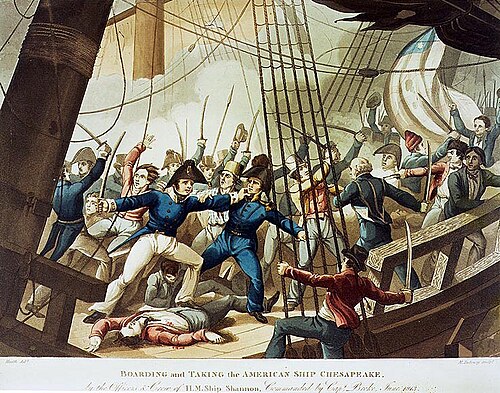
"The Boarding and Taking of the American Ship Chesapeake by the Officers and Crew of HMS Shannon" — after W. Heath, c. 1813. Hand-coloured engraving. National Maritime Museum, Greenwich. Public domain.
Opposing Forces
Capt. Philip Broke
Broke had commanded Shannon for seven years with obsessive attention to gunnery training
Casualties: 23 killed, 56 wounded (Broke severely wounded)
Capt. James Lawrence (killed)
Recently refitted with a partially new crew
Casualties: ~60 killed, ~85 wounded; ship captured
The action between HMS Shannon and USS Chesapeake, fought twenty miles east of Boston on 1 June 1813, was the most celebrated single-ship engagement of the age of sail and one of the most consequential naval actions of the nineteenth century. In eleven minutes of savage close-range combat, Captain Philip Broke’s meticulously trained crew destroyed the myth of American frigate invincibility, restored the confidence of the Royal Navy, and established British naval supremacy in the Atlantic for the remainder of the War of 1812.
The Context: American Frigate Victories and British Crisis
By June 1813, the American navy had inflicted a series of humiliating defeats on the Royal Navy in single-ship actions that had shaken the service to its foundations. USS Constitution had destroyed HMS Guerriere in August 1812 and HMS Java in December. USS United States under Stephen Decatur had captured HMS Macedonian in October 1812 — the only British frigate sailed to an American port as a prize. USS Hornet had sunk HMS Peacock in February 1813 in barely fifteen minutes.
These victories were genuine American achievements. The heavy frigates designed by Joshua Humphreys — Constitution, United States, President — were larger, more heavily armed, and more solidly constructed than standard British frigates. Their 24-pounder main batteries threw heavier broadsides than the 18-pounders carried by most British frigates of comparable rating. The officers and crews were skilled, well-trained, and aggressive.
But the psychological impact of these losses, particularly in Britain, was out of all proportion to their strategic significance. The Royal Navy had not lost a frigate action in years. The Times of London editorialised with alarm. The Admiralty launched inquiries. Parliament demanded explanations. The public, accustomed to two decades of almost unbroken naval supremacy since Trafalgar, was shaken. A service that controlled the world’s oceans found its self-image threatened by a navy of fewer than twenty ships.
Philip Broke: Seven Years of Preparation
Captain Philip Bowes Vere Broke was the antithesis of complacency. He had commanded HMS Shannon — a 38-gun frigate of standard British construction — for seven years, an unusually long commission that he had devoted to a single obsession: making his crew the finest gunners in the Royal Navy.
Broke spent personal funds on training equipment and innovations that were ahead of standard naval practice. He devised aiming systems using notched sights filed into the base rings of his guns — crude by later standards but revolutionary for an era when naval gunnery relied almost entirely on the judgement of individual gun captains. He chalked marks on the deck to help gunners estimate the angle of deflection at different ranges. He drilled his crew relentlessly, conducting live-fire exercises when ammunition regulations permitted and dry-fire drills when they did not.
His gun crews could deliver three aimed broadsides in under four minutes — a rate of fire that was exceptional by any standard and devastating in its accuracy. Shannon’s gunnery was not merely fast; it was precise. Broke trained his men to aim at specific targets on an enemy vessel: the quarterdeck, the wheel, the officers. He understood that destroying an enemy’s command structure in the opening minutes would produce chaos that weight of broadside alone could not achieve.
Shannon had been blockading Boston since April 1813, waiting for an opportunity. Broke wanted to fight, but he wanted to fight on his terms — ship against ship, with no interference from the American shore batteries or other vessels. When Captain James Lawrence assumed command of USS Chesapeake in May 1813, Broke saw his chance.
The Challenge
Broke drafted a formal letter of challenge — essentially an invitation to single combat between frigates — that was both chivalrous and calculating. The letter proposed that the two ships meet alone, without interference, at a time and place of Lawrence’s choosing. It was a document in the tradition of the formal duel: polite in form, lethal in intent.
Lawrence sailed before the letter reached him, but the outcome was the same. On the morning of 1 June, Chesapeake put to sea from Boston harbour. She flew a banner emblazoned “Free Trade and Sailors’ Rights” — the slogan of the American war party. Lawrence was confident, aggressive, and eager to add to the reputation he had earned commanding USS Hornet against HMS Peacock.
Boston Watches
The spectacle that followed was extraordinary even by the dramatic standards of the age of sail. Bostonians streamed to every available vantage point along the harbour heights, from Lynn to Scituate, to watch what they confidently expected would be another American triumph. Boats crowded the bay with spectators. A banquet hall had been reserved in Boston for the victory celebration. The local press had all but written their dispatches in advance. Wagers were laid at long odds against the British.
Chesapeake’s crew was partially new. Lawrence had assumed command only weeks earlier, and the crew had not been fully worked up together. Several experienced petty officers had been transferred to other ships. The crew was competent but not the practiced team that had served under previous commanders. This would matter.
Eleven Minutes
The ships closed in the late afternoon. Shannon lay to, waiting. Chesapeake bore down from the harbour. At approximately 5:50 p.m., the ships were within fifty yards of each other — pistol shot range. The opening broadside would be decisive.
Shannon fired first. Seven years of gunnery training produced a concentration of fire that swept Chesapeake’s quarterdeck with devastating precision. The accuracy was unprecedented — Shannon’s gunners were hitting not just the ship but specific positions on the ship. The first broadside killed or wounded the sailing master, the marine officer, and the boatswain. The second broadside killed the fourth lieutenant and shattered the wheel. Within the first three minutes, virtually every officer on Chesapeake’s quarterdeck was dead or disabled.
The effect on Chesapeake’s crew was catastrophic. Without officers to direct the fire, the gun crews began to falter. Without the wheel, the ship could not be manoeuvred. Chesapeake swung into the wind and lost way, her stern drifting toward Shannon’s bow — a position that exposed her to raking fire down the length of her deck.
Lawrence was struck by a musket ball fired by one of Shannon’s marine sharpshooters stationed in the tops. The ball entered below his knee and severed an artery. He was carried below, bleeding heavily. His last coherent words on deck — “Don’t give up the ship!” — would become the United States Navy’s most famous motto. They carry an irony that has not diminished in two centuries: the ship was, in fact, given up within minutes of his departure.
The Boarding
Broke, seeing the moment, led the boarding party personally. It was an act of supreme courage — and, for an officer of his experience and value, extraordinary recklessness. He leaped from Shannon’s rail onto Chesapeake’s deck at the head of approximately fifty men: marines, sailors, and officers armed with cutlasses, pikes, and pistols.
What followed was the most intense close-quarters combat of the war. On Chesapeake’s deck, in a space barely thirty feet wide, British and American sailors fought with cutlasses, boarding axes, and bare fists. The fighting was hand-to-hand, face-to-face, and utterly savage. Men grappled in the blood that made the deck treacherous underfoot.
Broke was struck by a sabre blow to the head that fractured his skull and exposed his brain. He fell, and a marine pulled him to safety. Despite the severity of the wound — which would have killed most men — Broke survived. He never fully recovered. The wound plagued him for the remaining decades of his life, causing seizures, headaches, and episodes of confusion. He never commanded at sea again.
His men overwhelmed the American crew in minutes. Some of Chesapeake’s crew fought with desperate courage — the chaplain was found dead on the gun deck, having fought with a cutlass. Others, leaderless and demoralised, surrendered or retreated below. The American flag was hauled down. The British colours were raised.
The entire action, from the first broadside to the hauling down of the American colours, lasted eleven minutes. The casualty rate — approximately twenty men killed or wounded per minute — was among the highest ever recorded in a frigate engagement and would rarely be matched in the remaining decades of the sailing navy.
The Butcher’s Bill
Chesapeake’s casualties were devastating: approximately 48 killed (including several who died of wounds in the days following) and 99 wounded — nearly 40 percent of her crew. Lawrence died on 4 June, three days after the action, aboard Shannon during the passage to Halifax. His body was preserved and later repatriated to Trinity Church in New York, where he was buried with full honours.
Shannon’s casualties, though lighter, were significant: 23 killed and 56 wounded, including Broke himself. The disparity reflected both the superiority of Shannon’s gunnery and the one-sided nature of the command destruction that Broke’s targeting had achieved.
Halifax: Triumph and Mourning
Shannon sailed into Halifax harbour on 6 June with her prize in company. The reception was extraordinary. Church bells rang. The streets filled with Haligonians who had followed the war’s naval news with intense personal interest — Halifax was the Royal Navy’s principal North American base, and many families had connections to the service. The arrival of Chesapeake under British colours was confirmation that the string of American victories had been broken.
Lawrence was buried in Halifax with full naval honours — a gesture of professional respect that transcended the enmity of war. British officers carried his coffin. The ceremony was attended by both the garrison and the civilian population. It was an acknowledgement that Lawrence had fought with courage, even if his judgement in accepting the engagement with an unprepared crew was open to question.
The Strategic Significance
The Shannon-Chesapeake action was the naval war’s turning point. It ended the string of American frigate victories that had shaken British confidence and inflated American expectations. Combined with the tightening blockade of the American coast, it established British naval supremacy in the Atlantic for the remainder of the war. No American frigate would win a single-ship action against the Royal Navy after 1 June 1813.
Andrew Lambert, in The Challenge, identifies the action as the most important frigate engagement ever fought — not for its tactical complexity, which was minimal, but for its strategic and psychological consequences. The early American victories had created a crisis of confidence within the Royal Navy. Shannon’s eleven-minute destruction of Chesapeake resolved that crisis at a stroke. Lambert argues that the action “secured British control of the Atlantic” for the remainder of the war.
Donald Hickey, the leading American historian of the war, acknowledges the significance from the American perspective: the string of frigate victories had created unrealistic expectations among the American public about what the navy could achieve. Shannon ended those expectations. After 1 June 1813, the American naval war became a defensive struggle — a matter of survival rather than challenge.
Jon Latimer places the engagement in the context of British naval tradition: Broke’s obsessive preparation was characteristic of the finest Royal Navy captains of the Napoleonic era. What distinguished him was not talent alone but the application of seven years of uninterrupted focus to a single objective. The result was not a battle but a demonstration of what disciplined gunnery could achieve.
The Admiralty issued a general memorandum commending Broke’s action and distributing details of his gunnery methods to the fleet. Broke was made a baronet. Shannon’s bell remains in the Maritime Museum of the Atlantic in Halifax, where the battle is commemorated with a clarity that would surprise most Americans — for whom the war’s naval history begins and ends with “Old Ironsides.”
The engagement demonstrated a truth that the early American victories had obscured: when a British frigate was properly trained, properly led, and commanded by an officer who had spent years preparing for exactly this kind of fight, it was more than a match for any opponent. The American advantage had been in ship construction — heavier hulls, heavier guns. Broke proved that the human element — training, discipline, tactical preparation — could overcome a material disadvantage. It was a lesson that navies would study for generations.
Significance
The most consequential single-ship action of the Age of Sail. Shannon's eleven-minute destruction of Chesapeake ended the American run of frigate victories, restored Royal Navy morale throughout the fleet, and established British naval supremacy in the Atlantic for the remainder of the war. Philip Broke's seven years of gunnery preparation produced an engagement that Lambert calls "the most important frigate action ever fought."