Raid on York
27 April 1813
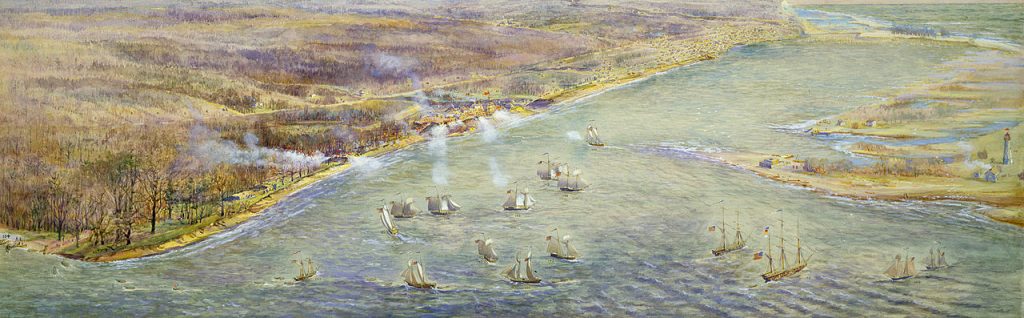
American fleet arriving at York, 27 April 1813. Owen Staples. Public domain.
Opposing Forces
Maj. Gen. Roger Sheaffe
Regulars (8th Foot), militia, Ojibwe and Mississauga warriors
Casualties: 82 killed, 112 wounded, 274 captured
Brig. Gen. Zebulon Pike (killed)
Regulars supported by Chauncey's Lake Ontario squadron
Casualties: 55 killed, 265 wounded (Pike killed by magazine explosion)
The American raid on York (present-day Toronto), the capital of Upper Canada, on 27 April 1813 was one of the war’s most tactically successful American operations and, simultaneously, one of its most consequential in terms of long-range retaliation. The burning of York’s parliament buildings and the looting of the town would be cited – explicitly and repeatedly – when British forces entered Washington in August 1814.
The attack on York was part of a broader American strategy for the 1813 campaign season. Commodore Isaac Chauncey’s Lake Ontario squadron would transport an assault force to York, where the objective was twofold: to destroy a warship under construction (the Sir Isaac Brock, a 24-gun corvette) and to capture military stores that could be used for subsequent operations against the Niagara frontier. York itself was lightly defended – Sheaffe had approximately 750 troops, a mix of regulars, militia, and Indigenous warriors.
The American force of approximately 1,700 regulars under Brigadier General Zebulon Pike – the explorer who had earlier attempted to find the headwaters of the Mississippi and for whom Pike’s Peak is named – landed west of the town on the morning of 27 April, supported by covering fire from Chauncey’s ships. The landing was contested but successful, and the Americans pushed eastward toward the town’s defences.
Sheaffe’s defence was competent but outmatched. His regulars and Ojibwe warriors fought a withdrawal action through the woods west of the town, but the weight of the American assault and the naval gunfire support proved too much. As the British position became untenable, Sheaffe made the decision to retreat with his regulars toward Kingston, effectively abandoning York’s militia and civilian population to their fate.
It was during the final American advance that the most dramatic incident of the battle occurred. As Pike’s troops approached the main magazine, a massive explosion tore through the fortification. Whether the magazine was deliberately detonated by the retreating British or exploded accidentally has never been conclusively established – British accounts generally describe it as an accident, while some American sources alleged deliberate sabotage. The blast killed Pike – struck by falling debris – and inflicted heavy casualties on the surrounding troops. In total, the explosion killed or wounded over 200 Americans, making it the single most destructive moment of the entire battle.
Pike’s death, combined with the casualties from the explosion, infuriated the American troops. What followed was several days of conduct that, while not unprecedented in the wars of the period, would have enduring consequences. American soldiers burned the parliament buildings of Upper Canada – the legislative assembly and other government structures. Private homes and businesses were also looted, though the extent of civilian property destruction remains debated. The church was broken into. The town’s library was plundered.
The burning of the government buildings was the critical act. When British forces under Major General Robert Ross entered Washington on 24 August 1814 and proceeded to burn the White House, the Capitol, and other public buildings, Ross and Rear Admiral Cockburn explicitly cited the American conduct at York as justification. The destruction of Newark (Niagara-on-the-Lake) by retreating American forces in December 1813 added further fuel. The burning of Washington was not an act of wanton destruction – it was, in the British view, a measured act of retaliation for American destruction of Canadian government buildings and civilian property.
This chain of causation – from York to Newark to Washington – is essential to any honest account of the war. The burning of Washington cannot be understood in isolation; it was the culmination of a cycle of destruction and retaliation that began with the American raid on the Canadian capital. The responsibility for initiating that cycle lies with the attackers, not the retaliators.
York itself was not held. The Americans departed after several days, having destroyed the warship under construction and captured some military stores, though less than hoped. Sheaffe was subsequently relieved of command, partly for abandoning York but more broadly for his uninspired management of the Niagara theatre. The American victory was real but limited – a successful raid, not a permanent conquest.
Significance
The American destruction at York provided the explicit British justification for the burning of Washington sixteen months later - a direct line of cause and effect that is essential to understanding both events.