The Burning of Washington
24-25 August 1814
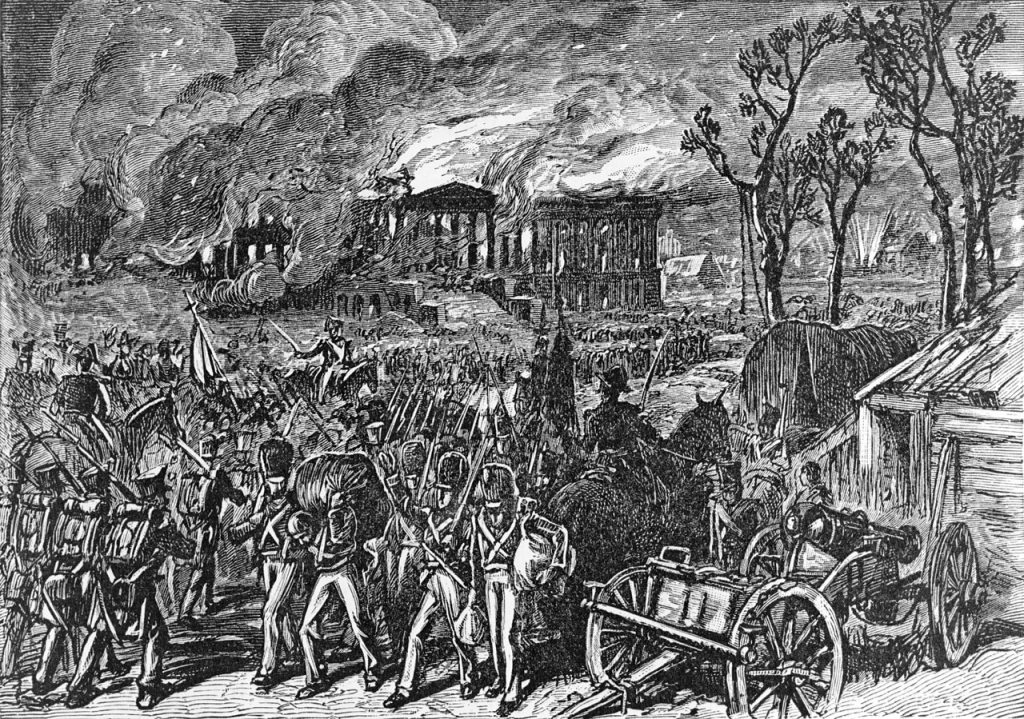
Burning of Washington, 24 August 1814. Public domain.
Opposing Forces
Maj. Gen. Robert Ross, Rear Adm. George Cockburn
As at Bladensburg
Casualties: Minimal (~30 from accidental magazine explosion)
N/A - capital evacuated
Government and population had fled
Casualties: Extensive destruction of public property; national humiliation
On the evening of 24 August 1814, British forces entered the capital of the United States unopposed. Over the following hours, they systematically burned the principal public buildings of the American government – the Capitol, the President’s House (as the White House was then known), the Treasury, the War and State Departments, an arsenal, and a dockyard with a frigate under construction. It was, and remains, the only occasion since the American Revolution on which a foreign power captured and occupied Washington.
The city that Ross and Cockburn entered was largely deserted. The government had fled following the debacle at Bladensburg. President Madison had departed on horseback; Dolley Madison, in one of the war’s most famous episodes, had supervised the removal of a full-length portrait of George Washington by Gilbert Stuart before leaving the President’s House. The British found the table laid for dinner in the abandoned mansion – a detail noted with some amusement by Cockburn, who reportedly ate some of the food before ordering the building’s destruction.
The burning was conducted with a degree of discipline that has been insufficiently acknowledged in American accounts. Ross and Cockburn directed the destruction specifically at government and military property. Private dwellings, commercial buildings, and churches were, as a matter of policy, left intact. Looting was forbidden and, when discovered, was punished. Several contemporary American witnesses – including residents who remained in the city during the occupation – recorded their surprise at the restraint shown toward non-government property.
This restraint was not accidental. It reflected a deliberate British policy of targeted retaliation rather than indiscriminate destruction. The stated justification was explicit and specific: the American burning of the parliament buildings at York (Toronto) in April 1813, and the destruction of the town of Newark (Niagara-on-the-Lake) in December 1813. At Newark, the American commander Brigadier General George McClure had ordered the town burned in midwinter, leaving approximately 400 civilian families – men, women, children, and the elderly – homeless in freezing temperatures. The memory of Newark was fresh in the minds of officers and soldiers alike.
Ross was careful to distinguish between public and private targets. The Capitol was burned, including the Library of Congress – a loss that Thomas Jefferson would partially remediate by selling his personal collection to the government. The President’s House was gutted. The Treasury and the departments of War and State were destroyed. But the residential neighbourhoods of Washington were left standing, and the Patent Office was spared after its superintendent, William Thornton, argued that its contents – models and drawings of American inventions – constituted private intellectual property rather than government assets. The argument was accepted.
The one significant British casualties came not from American resistance but from an accident. A detachment investigating a building near Greenleaf Point triggered a magazine explosion that killed or wounded approximately thirty soldiers. This was the only substantial loss the British suffered during the entire Washington operation.
The burning of Washington served multiple purposes. It was an act of military retaliation, explicitly linked to American conduct in Canada. It was a demonstration of power – proof that Britain could strike at the heart of the United States when it chose to do so. And it was a psychological blow of the first order, humiliating the Madison administration and undermining the war party’s claim that the conflict was going well.
On the evening of 25 August, a violent thunderstorm struck Washington – some accounts describe it as a tornado. The storm extinguished some of the fires and made conditions miserable for the occupying troops. Ross, having achieved his objective and recognising that the destruction of public buildings was complete, ordered a withdrawal that night. The British departed as quickly as they had arrived, marching back to their ships in the Chesapeake.
The political consequences within the United States were significant. The burning of Washington embarrassed the Madison administration, energised the anti-war Federalist movement (which would convene the Hartford Convention in December), and created a sense of crisis that would persist until the end of the war. It also generated, paradoxically, a surge of patriotic sentiment – a determination that the humiliation would not stand. The defence of Baltimore three weeks later, and the successful resistance at Fort McHenry that inspired the national anthem, were fuelled in part by the rage and shame of Washington’s fall.
In the longer perspective of history, the burning of Washington illustrates a point that American popular memory has been reluctant to acknowledge: the United States initiated this war with the invasion of its neighbour, burned the capital of Upper Canada, destroyed civilian communities in midwinter, and then found itself unable to protect its own capital from retaliation. The chain of cause and effect runs in one direction, however uncomfortable that direction may be.
Significance
The burning of Washington demonstrated that the United States, having launched an invasion of its neighbour, could not defend its own seat of government. It remains the only capture of Washington by a foreign power since the Revolution.