The Fall of Detroit
16 August 1812
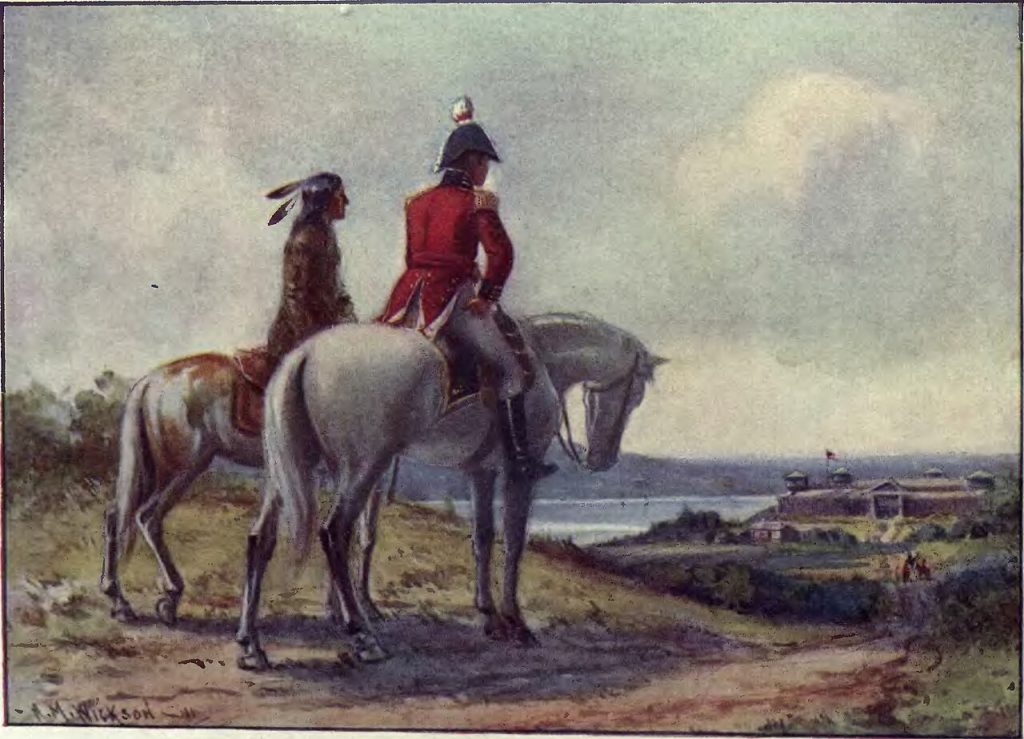
"Surrender of Detroit" — unknown artist, c. 1848. Oil on canvas. Public domain.
Opposing Forces
Maj. Gen. Isaac Brock & Tecumseh
330 regulars (41st Foot), 400 militia, ~600 Indigenous warriors
Casualties: 2 wounded
Brig. Gen. William Hull
Regulars and Ohio militia, plus the Michigan Territory garrison
Casualties: 7 killed, 2,493 captured with all stores and artillery
The fall of Detroit on 16 August 1812 stands as one of the most remarkable episodes in British military history and one of the most humiliating in American military annals. A garrison of 2,500 men, with substantial artillery and fortifications, surrendered to a force roughly half its size without a general engagement. The victory was achieved not through superior numbers or firepower, but through audacity, deception, and an alliance between British regulars and Tecumseh’s Indigenous confederacy that proved devastatingly effective.
The American campaign in the northwest had begun with considerable optimism. Brigadier General William Hull, a sixty-year-old veteran of the Revolutionary War and the governor of Michigan Territory, crossed into Upper Canada from Detroit on 12 July 1812 with approximately 2,500 men. He issued a grandiloquent proclamation to the Canadian population, promising liberation from British tyranny and warning that any man found fighting alongside Indigenous warriors would receive no quarter. The proclamation achieved nothing beyond irritating the Canadians and alerting the British to his intentions.
Hull’s confidence evaporated rapidly. On 17 July, Fort Mackinac fell to the British without a shot—news that reached Hull within days and convinced him that Indigenous nations across the region were rallying to the British cause. His supply lines from Ohio were threatened by raiding parties. A detachment sent to escort a supply column was ambushed at Brownstown on 5 August. Hull retreated across the river to Detroit on 8 August without having fought a significant engagement in Canada.
Major General Isaac Brock, the administrator of Upper Canada and its most dynamic military leader, moved with characteristic speed. Leaving York (Toronto) on 6 August, he reached Amherstburg on 13 August—a journey of some 300 miles in seven days. There he conferred with Tecumseh, whose warriors had been operating in the region since before the declaration of war. The two men, different in almost every conceivable way, formed an immediate and effective partnership.
Brock’s plan was built on calculated deception. He dressed his 400 militia in discarded red coats, making them indistinguishable at a distance from regular infantry. Tecumseh arranged for his warriors to march in a visible loop through clearings in the treeline surrounding the fort, creating the impression that the Indigenous force numbered in the thousands rather than hundreds. A letter was composed and deliberately allowed to be intercepted by American scouts, suggesting that 5,000 additional warriors were approaching from the north.
On 15 August, Brock sent Hull a formal demand for surrender. The letter was carefully crafted. It acknowledged Hull’s reputation and military career, expressed a desire to avoid unnecessary bloodshed, and then delivered the critical sentence: once the engagement commenced, he could not be responsible for the conduct of his Indigenous allies. This was not an idle threat—the spectre of an uncontrolled Indigenous assault on a fort containing soldiers’ families, including Hull’s own daughter and grandchildren, was designed to exploit Hull’s deepest fears.
Hull refused the initial demand. Brock responded by positioning his artillery across the river and opening a bombardment of the fort on the morning of 16 August. Simultaneously, he crossed the river south of the fort with his combined force—some 330 regulars, 400 militia in red coats, and 600 of Tecumseh’s warriors. The British column advanced in full view of the fort’s defences.
At this point, Hull’s nerve failed entirely. The American garrison was larger than Brock’s entire force, the fort was well-supplied, and the defences were substantial. Two of Hull’s own officers—Colonels Lewis Cass and Duncan McArthur—were in the field with a combined force of 400 men and could have attacked Brock’s column from behind. But Hull, convinced he faced an overwhelming enemy and consumed by fear for the civilian population, ordered the white flag raised.
The terms of surrender encompassed the entire Michigan Territory. Some 2,500 American soldiers marched into captivity. Thirty-three pieces of artillery, the brig Adams, substantial military stores, and the territory itself passed into British hands. British casualties amounted to two men wounded during the preliminary bombardment. It was, by any measure, one of the most lopsided surrenders in military history.
The consequences were transformative. The American northwest was exposed. Ohio and Indiana lay open to raids. The assumption—confidently held by Jefferson, Clay, and the War Hawks—that Canada would fall to a mere matter of marching was destroyed in a single morning. The British-Indigenous alliance was vindicated as a military combination of extraordinary potency. And Brock, already respected, became a legend—the saviour of Upper Canada.
Hull was later court-martialled and sentenced to death for cowardice, though the sentence was remitted by President Madison in recognition of his Revolutionary War service. The fall of Detroit would haunt the American war effort for years to come.
Significance
The surrender eliminated the American position in the northwest, secured the British-Indigenous alliance, and demonstrated that the conquest of Canada would not be the straightforward undertaking its advocates had promised.