USS Constitution vs HMS Guerriere
19 August 1812
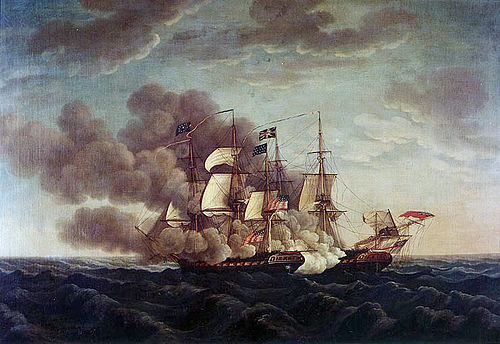
Constitution vs Guerriere, 19 August 1812. Michel Felice Corne. Public domain.
Opposing Forces
Capt. James Richard Dacres
38-gun frigate, originally French-built, light construction, in poor condition after extended service
Casualties: 15 killed, 63 wounded; ship destroyed
Capt. Isaac Hull
44-gun heavy frigate with 24-pounder main battery, live-oak hull construction
Casualties: 7 killed, 7 wounded
The action between USS Constitution and HMS Guerriere, fought approximately 400 miles southeast of Halifax on 19 August 1812, was the first major frigate engagement of the War of 1812 and one of the most psychologically significant naval actions in American history. In approximately thirty minutes of close-range combat, the American heavy frigate destroyed a British opponent, shattered the assumption of Royal Navy invincibility, and earned herself the nickname that she carries to this day: “Old Ironsides.”
The context is important. By August 1812, the Royal Navy had not lost a frigate action in years. Trafalgar in 1805 had confirmed British naval supremacy, and the subsequent seven years of dominance had produced a confidence – bordering on complacency – that the fleet was essentially unbeatable in single-ship engagements. The American declaration of war was viewed in British naval circles with something between contempt and bemusement: the United States Navy possessed fewer than twenty seagoing warships against a Royal Navy of over 600.
What this assessment failed to account for was the qualitative advantage of American frigates. The United States had invested heavily in a small number of exceptionally well-built warships. Constitution, designed by Joshua Humphreys and launched in 1797, was larger, heavier, and more powerfully armed than any European frigate of comparable rating. Her hull was constructed of dense live oak – a timber so hard that it could defeat round shot at certain ranges and angles. Her main battery of thirty 24-pounder long guns threw a broadside weight of approximately 684 pounds, against the 556 pounds of a standard British 38-gun frigate armed with 18-pounders.
Captain Isaac Hull, commanding Constitution, encountered Guerriere under Captain James Richard Dacres on the afternoon of 19 August. Guerriere was a captured French vessel of lighter construction, and her hull was reportedly in poor condition after extended service without adequate maintenance. The material disparity between the two ships was significant before a shot was fired.
Dacres opened fire at long range, but his 18-pounder shot proved largely ineffective against Constitution’s dense hull. American witnesses later recalled that British round shot was observed bouncing off the ship’s sides – the origin of the “Old Ironsides” sobriquet, supposedly coined by a sailor who exclaimed “Huzzah! Her sides are made of iron!” Hull closed the range to within pistol shot before ordering his broadside, and the effect was devastating. Constitution’s 24-pounders tore through Guerriere’s lighter construction with terrible efficiency.
Within fifteen minutes, Guerriere’s mizzenmast fell. Her mainmast and foremast followed shortly after, leaving her a dismasted hulk wallowing in the Atlantic swell. Dacres, wounded and with his ship reduced to wreckage, had no choice but to surrender. The shattered Guerriere was too damaged to be taken as a prize; she was burned the following day.
British casualties were 15 killed and 63 wounded. American losses were remarkably light: 7 killed and 7 wounded. The disparity reflected both the superiority of American gunnery in this particular action and the one-sided nature of the material advantage.
The psychological impact was enormous, entirely out of proportion to the strategic significance. In Britain, the loss produced something close to shock. The Admiralty, Parliament, and the press struggled to process a result that contradicted seven years of accumulated confidence. Inquiries were launched. Dacres was court-martialled (and honourably acquitted, the court recognising the material disparity). The Times of London editorialised with alarm about the implications.
In the United States, the reaction was euphoric. Constitution’s victory was celebrated as proof that America could challenge British naval power – a conclusion that was emotionally satisfying but strategically misleading. One frigate action, however decisive, did not alter the balance of naval power. The Royal Navy still possessed over 600 warships. The American navy still had fewer than twenty. The blockade that would strangle American commerce was already being planned.
As Andrew Lambert has observed, the early American frigate victories need to be understood in their proper context. They were genuine tactical achievements, won by well-built ships against opponents who were, in several cases, materially inferior. They demonstrated that American seamanship and gunnery could match or exceed British standards in favourable circumstances. But they had no effect whatsoever on the strategic balance. No other navy in the world did half as well against the British during this period – but no navy defeated the British by winning frigate duels. That was not how naval wars were won.
Constitution survived the war and is preserved today in Boston Harbor as the world’s oldest commissioned naval vessel still afloat. She remains a powerful symbol of American naval heritage – and a reminder that symbols and strategy are not the same thing.
Significance
A tactical victory enabled by superior ship construction and a significant broadside disparity. Strategically inconsequential to a navy of 600 ships, but psychologically powerful on both sides of the Atlantic.