USS Hornet vs HMS Penguin
23 March 1815
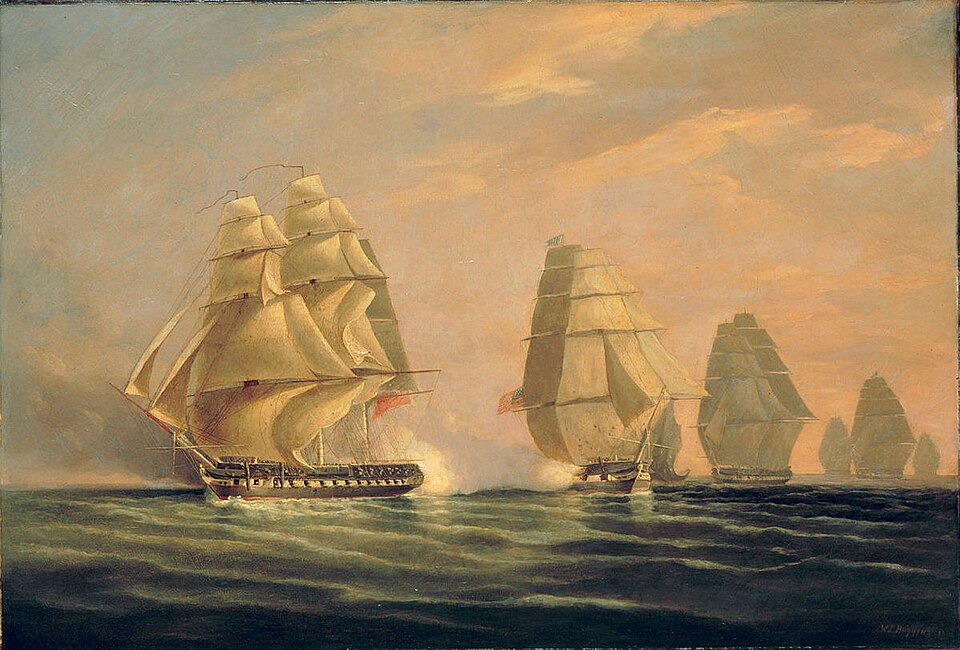
"USS Hornet" — unknown artist, early 19th century. Public domain.
Opposing Forces
Cmdr. James Dickinson (killed)
18-gun brig-sloop
Casualties: 14 killed (incl. Dickinson), 28 wounded; ship captured and destroyed
Capt. James Biddle
18-gun sloop-of-war
Casualties: 1 killed, 11 wounded
The action between USS Hornet and HMS Penguin, fought near the island of Tristan da Cunha in the South Atlantic on 23 March 1815, was the final single-ship action of the War of 1812 — fought nearly three months after the Treaty of Ghent had ended the conflict. Neither commander had received news of the peace, and the engagement was conducted in ignorance of the fact that the war it belonged to was already over.
Captain James Biddle’s Hornet was cruising in the South Atlantic as part of a small American squadron that had escaped the blockade in January 1815. Commander James Dickinson’s Penguin was a similar vessel — both rated at 18 guns, both brig-sloops of comparable size and armament. The ships were as evenly matched as any two warships of the period.
The engagement lasted approximately twenty-two minutes. Hornet’s gunnery was superior from the outset — her broadsides were delivered with a speed and accuracy that swept Penguin’s deck. Dickinson was killed early in the action, struck by a cannonball. His first lieutenant continued the fight but was quickly overwhelmed. After twenty-two minutes, with her captain dead, her hull holed, and her rigging in ruins, Penguin struck.
British casualties were 14 killed and 28 wounded. American losses were 1 killed and 11 wounded. Penguin was too damaged to be saved as a prize and was destroyed after her crew was transferred.
The Hornet-Penguin action was the final punctuation mark on the American naval war — a war that had produced a remarkable series of individual victories but that had, in strategic terms, been comprehensively lost. From the first broadside of Constitution against Guerriere in August 1812 to the last shots of Hornet against Penguin in March 1815, American naval officers had fought with a skill and courage that earned the respect of their opponents. But the blockade held. The frigates were captured. And the treaty that ended the war mentioned none of the maritime issues over which it had been declared.
Significance
The last ship-to-ship naval action of the war, fought nearly three months after the Treaty of Ghent. Both commanding officers had no knowledge of the peace.