USS United States vs HMS Macedonian
25 October 1812
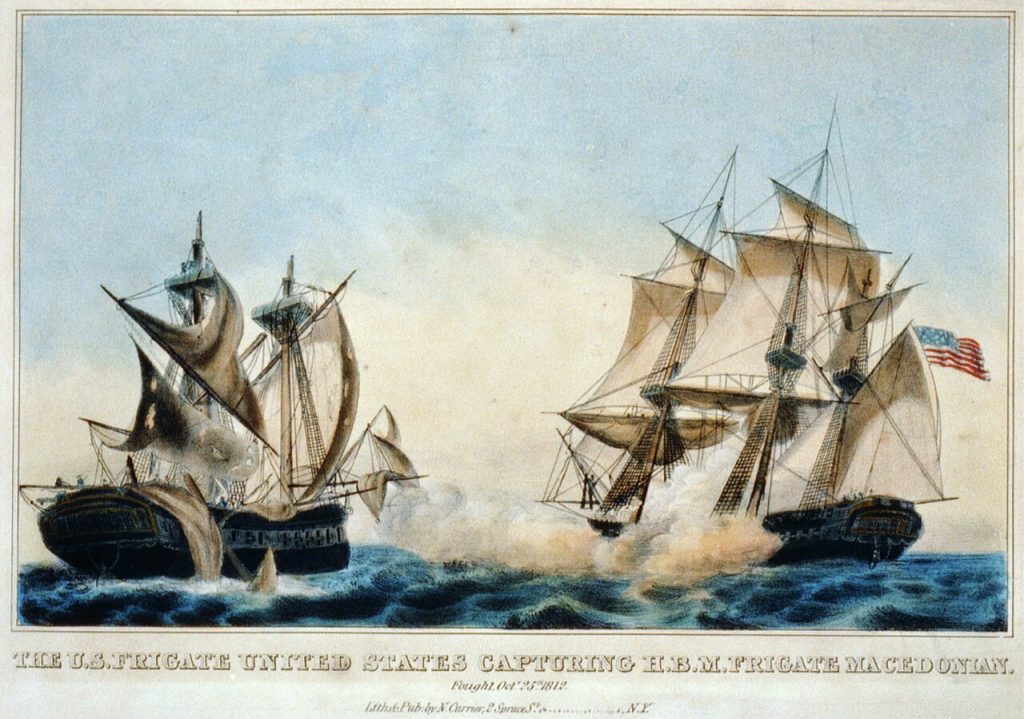
"Capture of HMS Macedonian by USS United States" — Thomas Birch, c. 1813. Oil on canvas. Public domain.
Opposing Forces
Capt. John Carden
38-gun frigate, relatively new vessel in good condition
Casualties: 36 killed, 68 wounded; ship captured
Cdre. Stephen Decatur
44-gun heavy frigate with 24-pounder long guns — the heaviest frigate armament afloat
Casualties: 5 killed, 7 wounded
The action between USS United States and HMS Macedonian, fought approximately 500 miles south of the Azores on 25 October 1812, was the most decisive of the early American frigate victories and the only one that produced a captured vessel sailed to an American port. Commodore Stephen Decatur’s handling of the engagement was a masterclass in exploiting a material advantage, and the casualty disparity — 12 American against 104 British — reflected the completeness of the American superiority.
Decatur, commanding the heavy frigate United States, was the most celebrated officer in the American navy. He had earned fame during the Barbary Wars and possessed both tactical skill and an instinct for aggressive action. His ship was the heaviest frigate afloat — her 24-pounder main battery threw a broadside of over 700 pounds, and her scantlings were thicker than those of many ships of the line.
Captain John Carden’s Macedonian was a newer vessel, well maintained and in fighting condition, but she was a standard 38-gun frigate armed with 18-pounders. The material disparity was significant before the engagement began: United States could hit harder, absorb more punishment, and fight at ranges where her heavier guns were effective and Macedonian’s lighter pieces were not.
Decatur exploited this advantage with precision. He opened the engagement at long range, where his 24-pounders could reach Macedonian while her 18-pounders fell short. The American gunnery was accurate and sustained, systematically dismasting Macedonian while keeping United States at a distance that minimised the risk to his own vessel. Macedonian’s mizzen mast fell first, then her main topmast. By the time Decatur closed to finish the action, his opponent was crippled.
Carden’s options were limited. His attempts to close the range and bring his carronades to bear — Macedonian’s short-range weaponry might have evened the odds at pistol range — were frustrated by the damage to his rigging. United States could dictate the range, and Decatur ensured that the range was always to his advantage.
After approximately ninety minutes, Macedonian was a dismasted wreck with over a hundred casualties. Carden struck his colours. British losses were 36 killed and 68 wounded; American losses were an astonishing 5 killed and 7 wounded. The disparity testified to Decatur’s ability to control the engagement on his own terms.
Macedonian was repaired at sea and sailed to New London, Connecticut, as a prize — the only British frigate to be taken into an American port during the war. She was subsequently commissioned into the American navy and served until the Civil War era. Her arrival in the United States produced a wave of celebration that reinforced the dangerous illusion that America was winning the naval war.
Carden was court-martialled upon his return to England but was honourably acquitted, the court recognising that the material odds had been overwhelmingly against him. The Admiralty’s response was more consequential: orders were issued prohibiting British frigates from engaging American 44-gun heavies in single combat. The instruction was an acknowledgement that American ship design had produced vessels that outclassed their British equivalents — a tactical fact that coexisted with the strategic reality of overwhelming British numerical supremacy.
Significance
The most one-sided of the early frigate actions. Macedonian was the only British frigate captured and sailed to an American port as a prize during the war.